


Page 604 - Business Principles and Management
P. 604
Chapter 22 • Pricing and Promotion


                        it is the price they pay their supplier to buy the product plus the cost of tran-
                        sporting it to their location for resale to their customers. For example, if the in-  facts
                        voice price of an item is $55 and the transportation charge is $5, the cost of    &
                        goods sold is $60.
                           Operating expenses are the costs of operating a business. They do not include        figures
                        costs involved in the actual production or purchase of merchandise, which would
                        be part of the cost of goods sold. Most costs involved in the day-to-day running
                        of a business fall into this category. Figure 22-3 (see p. 592) lists some common  Around 80 percent of car buy-
                        operating expenses.                                                      ers use Internet services that
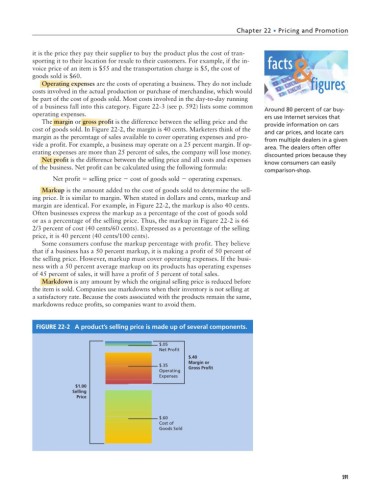
                           The margin or gross profit is the difference between the selling price and the
                        cost of goods sold. In Figure 22-2, the margin is 40 cents. Marketers think of the  provide information on cars
                                                                                                 and car prices, and locate cars
                        margin as the percentage of sales available to cover operating expenses and pro-  from multiple dealers in a given
                        vide a profit. For example, a business may operate on a 25 percent margin. If op-  area. The dealers often offer
                        erating expenses are more than 25 percent of sales, the company will lose money.  discounted prices because they
                           Net profit is the difference between the selling price and all costs and expenses
                        of the business. Net profit can be calculated using the following formula:  know consumers can easily
                                                                                                 comparison-shop.
                              Net profit  selling price  cost of goods sold  operating expenses.

                           Markup is the amount added to the cost of goods sold to determine the sell-
                        ing price. It is similar to margin. When stated in dollars and cents, markup and
                        margin are identical. For example, in Figure 22-2, the markup is also 40 cents.
                        Often businesses express the markup as a percentage of the cost of goods sold
                        or as a percentage of the selling price. Thus, the markup in Figure 22-2 is 66
                        2/3 percent of cost (40 cents/60 cents). Expressed as a percentage of the selling
                        price, it is 40 percent (40 cents/100 cents).
                           Some consumers confuse the markup percentage with profit. They believe
                        that if a business has a 50 percent markup, it is making a profit of 50 percent of
                        the selling price. However, markup must cover operating expenses. If the busi-
                        ness with a 50 percent average markup on its products has operating expenses
                        of 45 percent of sales, it will have a profit of 5 percent of total sales.
                           Markdown is any amount by which the original selling price is reduced before
                        the item is sold. Companies use markdowns when their inventory is not selling at
                        a satisfactory rate. Because the costs associated with the products remain the same,
                        markdowns reduce profits, so companies want to avoid them.


                         FIGURE 22-2 A product’s selling price is made up of several components.

                                                                $.05
                                                                Net Profit
                                                                         $.40
                                                                         Margin or
                                                                $.35
                                                                         Gross Profit
                                                                Operating
                                                                Expenses
                                     $1.00
                                    Selling
                                      Price


                                                                $.60
                                                                Cost of
                                                                Goods Sold


                                                                                                                          591

