


Page 607 - Business Principles and Management
P. 607
Unit 6


                                                producing and marketing the product, as well as all related operating expenses.
                                                It then sets the price by adding the amount necessary to make the target profit.
                                                But even setting prices based on a target profit won’t guarantee that the com-
                                                pany will make that profit. Customers must like the product well enough to buy
                                                it at that price. Also, competitors selling the same product might sell for less,
                                                luring away customers. In either case, the company may have to mark down its
                                                price to attract more buyers, reducing profit below its target.

                                                PRICING BASED ON CONSUMER DEMAND

                                                The owner of a business that carries fashion merchandise knows that at certain
                                                times the products will be in great demand, and at other times the demand will be
                                                very low. Swimsuits sell quickly early in the season but slowly late in the season,
                                                unless the retailer greatly reduces the prices. Because a retailer cannot accurately
                                                predict the exact number of suits it will sell, it will set a selling price at the begin-
                                                ning of the season that should ensure a net profit on the entire inventory of swim-
                                                suits, even though it may have to drastically reduce prices later in the season.
                                                   A manufacturer of a product that suddenly becomes popular may want to sell
                                                at a high price while the demand is great. When new competitors enter the mar-
                                                ket or customers tire of the product and demand begins to decline, the manufac-
                                                turer will need to sell the product at a much lower price.
                                                   The introduction of new products in the market presents an interesting study
                                                in price decisions. High-definition televisions (HDTVs) are growing in popularity.
                                                In the beginning, a few brands were priced extremely high—several thousand
                                                dollars—compared to standard televisions. As customer demand increased, many
                                                more competitors entered the market, and prices began to drop to between $1,000
                                                and $2,000. Eventually prices will drop even lower.

                                                PRICING TO SELL MORE PRODUCTS

                                                Products that are priced higher usually sell more slowly than those that cost the
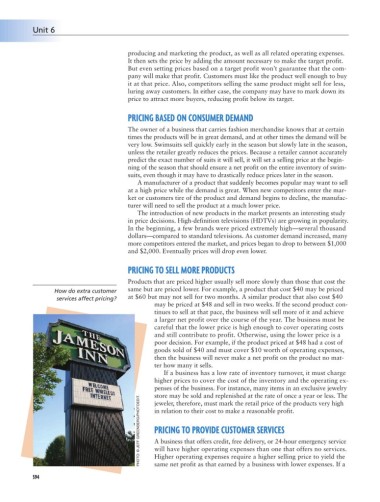
                         How do extra customer   same but are priced lower. For example, a product that cost $40 may be priced
                         services affect pricing?  at $60 but may not sell for two months. A similar product that also cost $40
                                                        may be priced at $48 and sell in two weeks. If the second product con-
                                                        tinues to sell at that pace, the business will sell more of it and achieve
                                                        a larger net profit over the course of the year. The business must be
                                                        careful that the lower price is high enough to cover operating costs
                                                        and still contribute to profit. Otherwise, using the lower price is a
                                                        poor decision. For example, if the product priced at $48 had a cost of
                                                        goods sold of $40 and must cover $10 worth of operating expenses,
                                                        then the business will never make a net profit on the product no mat-
                                                        ter how many it sells.
                                                           If a business has a low rate of inventory turnover, it must charge
                                                        higher prices to cover the cost of the inventory and the operating ex-
                                                        penses of the business. For instance, many items in an exclusive jewelry
                                                        store may be sold and replenished at the rate of once a year or less. The
                                                   PHOTO: © JEFF GREENBERG/PHOTOEDIT.  in relation to their cost to make a reasonable profit.
                                                        jeweler, therefore, must mark the retail price of the products very high


                                                        PRICING TO PROVIDE CUSTOMER SERVICES
                                                        A business that offers credit, free delivery, or 24-hour emergency service
                                                        will have higher operating expenses than one that offers no services.

                                                        same net profit as that earned by a business with lower expenses. If a

                  594                                   Higher operating expenses require a higher selling price to yield the

