


Page 603 - Business Principles and Management
P. 603
Unit 6


                                                                      than retailers). In this case, the manufacturer expects
                                                                      the wholesalers to perform additional marketing ac-
                                                                      tivities beyond those expected from retailers.
                                                                         A quantity discount is a price reduction offered to
                                                                      customers that buy in quantities larger than a specified
                                                                      minimum. For example, a retail paint store that orders
                                                                      200 gallons of paint from a wholesaler pays a certain
                                                                      price per gallon. However, the wholesaler may lower
                                                                      the price per gallon if the store orders at least 1,000
                                                                      gallons at one time. The purpose of the discount is to
                                                                  PHOTO: © GETTY IMAGES/PHOTODISC.  lower price because that sale reduces the cost of inven-
                                                                      encourage customers to buy in large quantities. The
                                                                      manufacturer can afford to sell the larger quantity for a

                                                                      tory, the amount of storage space needed, the insurance
                                                                      costs, and the administrative costs of product handling.
                                                                      Quantity discounts may be based on the number of
                                                                      units purchased or on the dollar value of the order.
                                                                         A seasonal discount is a price reduction offered for
                                                                      ordering or taking delivery of products in advance of
                                                                      the normal buying period. It encourages the buyer to
                                                                      purchase earlier than necessary or at a time when
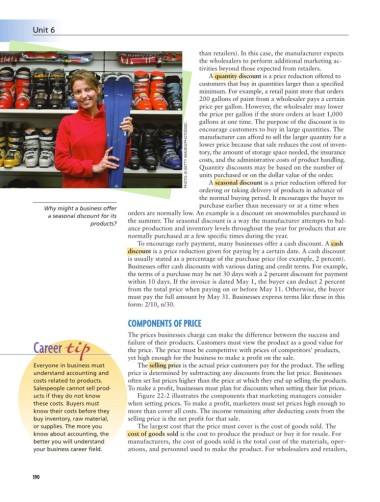
                     Why might a business offer
                                                orders are normally low. An example is a discount on snowmobiles purchased in
                       a seasonal discount for its
                                                the summer. The seasonal discount is a way the manufacturer attempts to bal-
                                    products?
                                                ance production and inventory levels throughout the year for products that are
                                                normally purchased at a few specific times during the year.
                                                   To encourage early payment, many businesses offer a cash discount. A cash
                                                discount is a price reduction given for paying by a certain date. A cash discount
                                                is usually stated as a percentage of the purchase price (for example, 2 percent).
                                                Businesses offer cash discounts with various dating and credit terms. For example,
                                                the terms of a purchase may be net 30 days with a 2 percent discount for payment
                                                within 10 days. If the invoice is dated May 1, the buyer can deduct 2 percent
                                                from the total price when paying on or before May 11. Otherwise, the buyer
                                                must pay the full amount by May 31. Businesses express terms like these in this
                                                form: 2/10, n/30.


                                                COMPONENTS OF PRICE
                  Career tip                    The prices businesses charge can make the difference between the success and
                                                failure of their products. Customers must view the product as a good value for
                                                the price. The price must be competitive with prices of competitors’ products,
                                                yet high enough for the business to make a profit on the sale.
                  Everyone in business must        The selling price is the actual price customers pay for the product. The selling
                  understand accounting and     price is determined by subtracting any discounts from the list price. Businesses
                  costs related to products.    often set list prices higher than the price at which they end up selling the products.
                  Salespeople cannot sell prod-  To make a profit, businesses must plan for discounts when setting their list prices.
                  ucts if they do not know         Figure 22-2 illustrates the components that marketing managers consider
                  these costs. Buyers must      when setting prices. To make a profit, marketers must set prices high enough to
                  know their costs before they  more than cover all costs. The income remaining after deducting costs from the
                  buy inventory, raw material,  selling price is the net profit for that sale.
                  or supplies. The more you        The largest cost that the price must cover is the cost of goods sold. The
                  know about accounting, the    cost of goods sold is the cost to produce the product or buy it for resale. For
                  better you will understand    manufacturers, the cost of goods sold is the total cost of the materials, oper-
                  your business career field.   ations, and personnel used to make the product. For wholesalers and retailers,


                  590

