


Page 437 - Basic College Mathematics with Early Integers
P. 437
414                            C HAPTE R 5 I RATIO, PROPORTION, AND MEASUREMENT


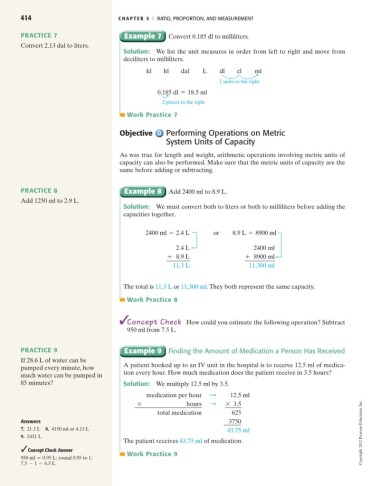
        PRACTICE 7                       Example 7     Convert 0.185 dl to milliliters.
        Convert 2.13 dal to liters.
                                        Solution:  We list the unit measures in order from left to right and move from
                                        deciliters to milliliters.
                                                kl   hl    dal    L    dl    cl   ml
                                                                       2 units to the right
                                                   0.185 dl=18.5 ml
                                                     2 places to the right
                                          Work Practice 7


                                       Objective      Performing Operations on Metric
                                                      System Units of Capacity

                                       As was true for length and weight, arithmetic operations involving metric units of
                                       capacity can also be performed. Make sure that the metric units of capacity are the
                                       same before adding or subtracting.


        PRACTICE 8                       Example 8     Add 2400 ml to 8.9 L.
        Add 1250 ml to 2.9 L.
                                        Solution:  We must convert both to liters or both to milliliters before adding the
                                        capacities together.


                                               2400 ml=2.4 L         or    8.9 L=8900 ml

                                                         2.4 L                    2400 ml
                                                      + 8.9 L                  + 8900 ml
                                                        11.3 L                   11,300 ml


                                        The total is 11.3 L or 11,300 ml.They both represent the same capacity.
                                          Work Practice 8


                                          Concept Check How could you estimate the following operation? Subtract
                                          950 ml from 7.5 L.


        PRACTICE 9                       Example 9 Finding the Amount of Medication a Person Has Received
        If 28.6 L of water can be
        pumped every minute, how        A patient hooked up to an IV unit in the hospital is to receive 12.5 ml of medica-
        much water can be pumped in     tion every hour. How much medication does the patient receive in 3.5 hours?
        85 minutes?                     Solution:  We multiply 12.5 ml by 3.5.
                                                medication per hour  :     12.5 ml

                                             *               hours  :   * 3.5
                                                   total medication        625
        Answers                                                           3750
        7. 21.3 L  8. 4150 ml or 4.15 L                                   43.75 ml                                  Copyright 2012 Pearson Education, Inc.
        9. 2431 L
                                        The patient receives 43.75 ml of medication.
          Concept Check Answer
                                          Work Practice 9
        950 ml = 0.95 L;  round 0.95 to 1;
        7.5 - 1 = 6.5 L

