


Page 441 - Basic College Mathematics with Early Integers
P. 441
Objective                   5.7        CONVERSIONS BETWEEN THE U.S. AND METRIC SYSTEMS

           Convert Between the U.S.
           and Metric Systems.
                                       Objective      Converting Between the U.S. and Metric Systems
                                       The metric system probably had its beginnings in France in the 1600s, but it was the
                                       Metric Act of 1866 that made the use of this system legal (but not mandatory) in the
                                       United States. Other laws have followed that allow for a slow, but deliberate, trans-
                                       fer to the modernized metric system. In April 2001, for example, the U.S. Stock
                                       Exchanges completed their change to decimal trading instead of fractions. By the
                                       end of 2009, all products sold in Europe (with some exceptions) were required to
                                       have only metric units on their labels. (Source: U.S. Metric Association and National
                                       Institute of Standards and Technology)
                                           You may be surprised at the number of everyday items we use that are already
                                       manufactured in metric units. We easily recognize 1L and 2L soda bottles, but what
                                       about the following?

                                           Pencil leads (0.5 mm or 0.7 mm)
                                           Camera film (35 mm)
                                           Sporting events (5-km or 10-km races)
                                           Medicines (500-mg capsules)
                                           Labels on retail goods (dual-labeled since 1994)
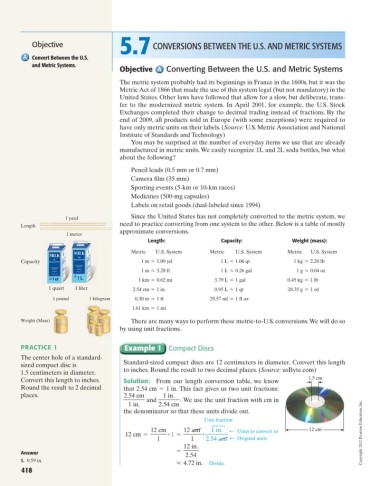
                                           Since the United States has not completely converted to the metric system, we
                      1 yard
                                       need to practice converting from one system to the other. Below is a table of mostly
        Length
                                       approximate conversions.
                      1 meter
                                                Length:                 Capacity:             Weight (mass):
                                           Metric        U.S. System  Metric         U.S. System  Metric       U.S. System
        Capacity                               1 m L 1.09 yd            1 L L 1.06 qt           1 kg L 2.20 lb
                                               1 m L 3.28 ft            1 L L 0.26 gal           1 g L 0.04 oz
                                              1 km L 0.62 mi          3.79 L L 1 gal          0.45 kg L 1 lb
                 1 quart  1 liter           2.54 cm = 1 in.           0.95 L L 1 qt           28.35 g L 1 oz
                  1 pound    1 kilogram      0.30 m L 1 ft           29.57 ml L 1 fl oz
                                            1.61 km L 1 mi

        Weight (Mass)                      There are many ways to perform these metric-to-U.S. conversions.We will do so
                                       by using unit fractions.


        PRACTICE 1                       Example 1 Compact Discs
        The center hole of a standard-
                                        Standard-sized compact discs are 12 centimeters in diameter. Convert this length
        sized compact disc is
                                        to inches. Round the result to two decimal places. (Source: usByte.com)
        1.5 centimeters in diameter.
        Convert this length to inches.  Solution:  From our length conversion table, we know       1.5 cm
        Round the result to 2 decimal   that 2.54 cm = 1 in.  This fact gives us two unit fractions:
        places.                          2.54 cm     1 in.
                                                and        .  We use the unit fraction with cm in
                                          1 in.     2.54 cm
                                        the denominator so that these units divide out.
                                                                  Unit fraction
                                                                    2
                                                 12 cm      12  cm   1 in.  ;  Units to convert to  12 cm
                                         12 cm =       #  1 =     #                                                 Copyright 2012 Pearson Education, Inc.
                                                   1          1    2.54  cm   ;  Original units
                                                            12 in.
        Answer                                            =
                                                            2.54
        1. 0.59 in.
                                                          L 4.72 in.  Divide.
        418

