


Page 442 - Basic College Mathematics with Early Integers
P. 442
S E C T I O N 5.7 I CONVERSIONS BETWEEN THE U.S. AND METRIC SYSTEMS                419

             Thus, the diameter of a standard compact disc is exactly 12 cm or approximately
             4.72 inches. For a dimension this size, you can use a ruler to check. Another
             method is to approximate. Our result, 4.72 in., is close to 5 inches. Since 1 in. is
             about 2.5 cm, then 5 in. is about 5(2.5 cm) = 12.5 cm,  which is close to 12 cm.
              Work Practice 1


             Example 2 Liver                                                            PRACTICE 2
                                                                                        A full-grown human heart
             The liver is your largest internal organ. It weighs about 3.5 pounds in a grown
                                                                                        weighs about 8 ounces. Convert
             man. Convert this weight to kilograms. Round to the nearest tenth. (Source: Some
                                                                                        this weight to grams. If neces-
             Body! by Dr. Pete Rowan)
                                                                                        sary, round your result to the
                                     Unit fraction
                                                                                        nearest tenth of a gram.
                                       L
                               3.5 lb 0.45 kg
             Solution:  3.5 lb L     #       = 3.5(0.45 kg) L 1.6 kg
                                 1     1lb
             Thus 3.5 pounds are approximately 1.6 kilograms. From the table of conversions,
             we know that 1 kg L 2.2 lb.  So that means 0.5 kg L 1.1 lb  and after adding, we
             have 1.5 kg L 3.3 lb.  Our result is reasonable.

              Work Practice 2


              Example 3 Postage Stamp                                                   PRACTICE 3
             Australia converted to the metric system in 1973. In                       Convert 237 ml to fluid ounces.
             that year, four postage stamps were issued to publi-                       Round to the nearest whole
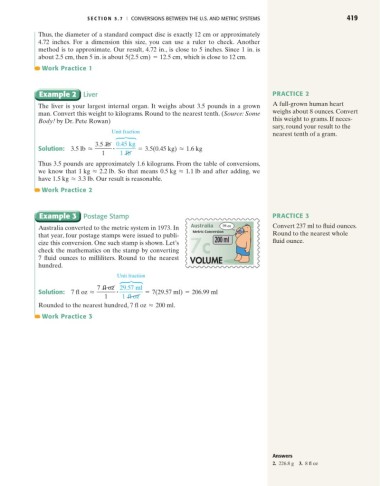
             cize this conversion. One such stamp is shown. Let’s                       fluid ounce.
             check the mathematics on the stamp by converting
             7 fluid ounces to milliliters. Round to the nearest
             hundred.
                                      Unit fraction
                                         L
                                7 fl oz 29.57 ml
             Solution:  7 fl oz L     #        = 7(29.57 ml) = 206.99 ml
                                  1     1 fl oz
             Rounded to the nearest hundred, 7 fl oz L 200 ml.
              Work Practice 3


                                                                                        Answers
                                                                                        2. 226.8 g  3. 8 fl oz

