


Page 513 - Basic College Mathematics with Early Integers
P. 513
490                            C HAPTE R 6 I PERCENT


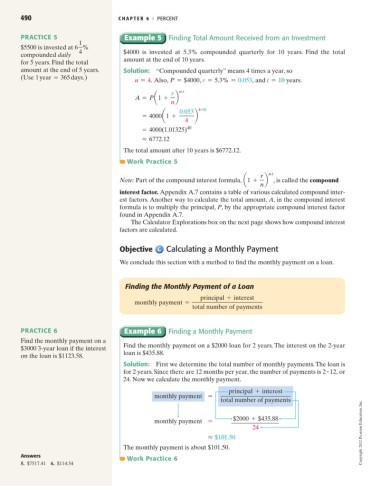
        PRACTICE 5                       Example 5 Finding Total Amount Received from an Investment
                          1
        $5500 is invested at 6  %
                          4             $4000 is invested at 5.3% compounded quarterly for 10 years. Find the total
        compounded daily
        for 5 years. Find the total     amount at the end of 10 years.
        amount at the end of 5 years.   Solution:  “Compounded quarterly” means 4 times a year, so
        (Use 1 year = 365 days .)
                                            n = 4. Also, P = $4000, r = 5.3% = 0.053, and t = 10 years.
                                                        r  n# t
                                              A = Pa1 +  b
                                                        n
                                                          0.053  4 # 10
                                                = 4000a1 +     b
                                                            4
                                                = 4000(1.01325) 40
                                                L 6772.12

                                        The total amount after 10 years is $6772.12.
                                          Work Practice 5

                                                                                    r  n . t
                                       Note: Part of the compound interest formula, a1 +  b  , is called the compound
                                                                                    n
                                       interest factor. Appendix A.7 contains a table of various calculated compound inter-
                                       est factors. Another way to calculate the total amount, A, in the compound interest
                                       formula is to multiply the principal, P, by the appropriate compound interest factor
                                       found in Appendix A.7.
                                           The Calculator Explorations box on the next page shows how compound interest
                                       factors are calculated.

                                       Objective      Calculating a Monthly Payment

                                       We conclude this section with a method to find the monthly payment on a loan.


                                         Finding the Monthly Payment of a Loan
                                                                 principal + interest
                                            monthly payment =
                                                              total number of payments


        PRACTICE 6                       Example 6 Finding a Monthly Payment
        Find the monthly payment on a
                                        Find the monthly payment on a $2000 loan for 2 years. The interest on the 2-year
        $3000 3-year loan if the interest
                                        loan is $435.88.
        on the loan is $1123.58.
                                        Solution:  First we determine the total number of monthly payments.The loan is
                                                                                                          #
                                        for 2 years. Since there are 12 months per year, the number of payments is 2 12,  or
                                        24. Now we calculate the monthly payment.
                                                                          principal+interest
                                                  monthly payment =
                                                                       total number of payments


                                                  monthly payment =        $2000+$435.88
                                                                                  24
                                                                   ≠$101.50                                         Copyright 2012 Pearson Education, Inc.
                                        The monthly payment is about $101.50.
        Answers
                                          Work Practice 6
        5. $7517.41  6. $114.54

