


Page 644 - Basic College Mathematics with Early Integers
P. 644
9.1       LINES AND ANGLES                                                     Objectives


                                                                                            Identify Lines, Line Segments,
                                                                                            Rays, and Angles.
            Objective      Identifying Lines, Line Segments,
                           Rays, and Angles                                                 Classify Angles as Acute, Right,
                                                                                            Obtuse, or Straight.
            Let’s begin with a review of two important concepts—space and plane.
                Space extends in all directions indefinitely. Examples of objects in space are  Identify Complementary and
            houses, grains of salt, bushes, your Basic College Mathematics textbook, and you.  Supplementary Angles.
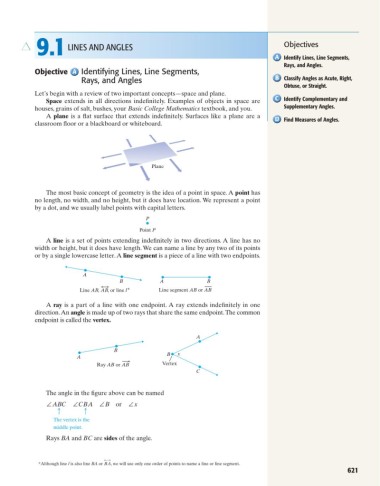
                A plane is a flat surface that extends indefinitely. Surfaces like a plane are a
                                                                                            Find Measures of Angles.
            classroom floor or a blackboard or whiteboard.


                                                 Plane


                The most basic concept of geometry is the idea of a point in space. A point has
            no length, no width, and no height, but it does have location. We represent a point
            by a dot, and we usually label points with capital letters.
                                                P

                                              Point P
                A line is a set of points extending indefinitely in two directions. A line has no
            width or height, but it does have length. We can name a line by any two of its points
            or by a single lowercase letter.A line segment is a piece of a line with two endpoints.


                           A
                                       B            A              B
                          Line AB, AB, or line l*   Line segment AB or AB
                A ray is a part of a line with one endpoint. A ray extends indefinitely in one
            direction.An angle is made up of two rays that share the same endpoint.The common
            endpoint is called the vertex.

                                                                A

                                     B
                                                      B   x
                          A
                                Ray AB or AB         Vertex
                                                                C


                The angle in the figure above can be named
                ∠ABC  ∠CBA  ∠B  or  ∠x
                   c        c
                  The vertex is the
                  middle point.
                Rays BA and BC are sides of the angle.


                                  ·
             *Although line l is also line BA or BA , we will use only one order of points to name a line or line segment.
                                                                                                                621

