


Page 540 - Basic Electrical Engineering
P. 540
6.4.1 Power Transformers and Distribution Transformers

               Power transformers are connected at the two ends of the transmission lines to
               step up or to step down the voltage. A number of such transformers are

               connected in parallel depending upon the amount of power to be transmitted.
               They are rated for high voltages, e.g. 11 kV/220 kV, 100 MVA. The size of

               such transformers is very large. They are installed outdoors in a substation.
                  Distribution transformers feed electricity to the consumers. They are rated

               for voltages like 11 kV/400 V. These transformers are generally of pole-
               mounted type and always remain energized being ready all 24 hours to
               supply electricity to the consumers. Even if there is no consumption of

               electricity from a distribution transformer, it has to remain energized all the
               time. The core losses of such transformers must be low by design. Otherwise,

               their all-day operating efficiency will be low.


                                                    6.5 EMF EQUATION

               We have known that EMFs are induced in the transformers primary and
               secondary windings when alternating flux link both of them. The frequency
               of alternation of the flux will depend upon the frequency of the primary

               supply voltage which is normally 50 Hz. The magnitude of the EMF induced
               in the two windings of a transformer will be different if they have different

               number of turns. Let us now derive the EMF equation. Referring to Fig. 6.6,
               and considering a sinusoidal input voltage, V  at a frequency, f, the flux
                                                                      1
               produced due to current, I  is ϕ = ϕ  sin ωt.
                                              0
                                                         m
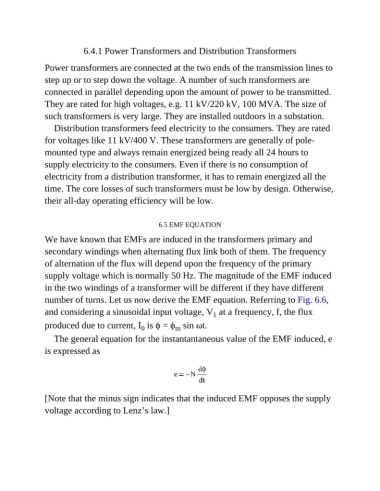
                  The general equation for the instantantaneous value of the EMF induced, e
               is expressed as


               [Note that the minus sign indicates that the induced EMF opposes the supply
               voltage according to Lenz’s law.]

