


Page 639 - Basic Electrical Engineering
P. 639
ϕ ∝ I  a


                                                         T ∝ ϕ I   a


                                                         T ∝ I   a 2


               Since I  R  is very small as compared to V, V − I R ϕ V = constant, and ϕ ∝
                        a
                            a
                                                                          a a
               I a


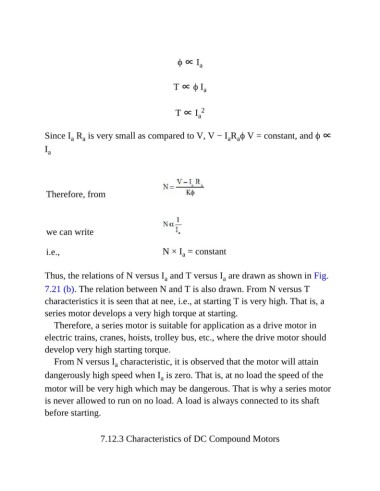
                Therefore, from


                we can write


                i.e.,                                N × I  = constant
                                                            a


               Thus, the relations of N versus I  and T versus I  are drawn as shown in Fig.
                                                      a
                                                                         a
               7.21 (b). The relation between N and T is also drawn. From N versus T
               characteristics it is seen that at nee, i.e., at starting T is very high. That is, a
               series motor develops a very high torque at starting.

                  Therefore, a series motor is suitable for application as a drive motor in
               electric trains, cranes, hoists, trolley bus, etc., where the drive motor should

               develop very high starting torque.
                  From N versus I  characteristic, it is observed that the motor will attain
                                      a
               dangerously high speed when I  is zero. That is, at no load the speed of the
                                                     a
               motor will be very high which may be dangerous. That is why a series motor
               is never allowed to run on no load. A load is always connected to its shaft
               before starting.


                                 7.12.3 Characteristics of DC Compound Motors

