


Page 644 - Basic Electrical Engineering
P. 644
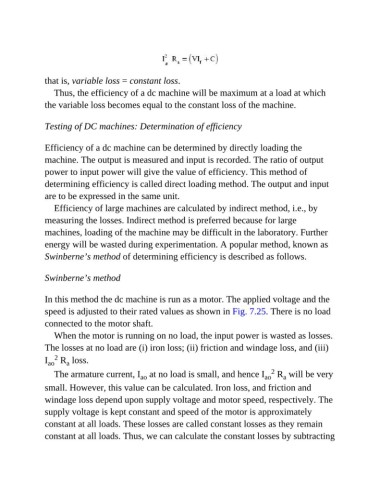
that is, variable loss = constant loss.
                  Thus, the efficiency of a dc machine will be maximum at a load at which
               the variable loss becomes equal to the constant loss of the machine.


               Testing of DC machines: Determination of efficiency


               Efficiency of a dc machine can be determined by directly loading the

               machine. The output is measured and input is recorded. The ratio of output
               power to input power will give the value of efficiency. This method of
               determining efficiency is called direct loading method. The output and input

               are to be expressed in the same unit.
                  Efficiency of large machines are calculated by indirect method, i.e., by

               measuring the losses. Indirect method is preferred because for large
               machines, loading of the machine may be difficult in the laboratory. Further

               energy will be wasted during experimentation. A popular method, known as
               Swinberne’s method of determining efficiency is described as follows.


               Swinberne’s method


               In this method the dc machine is run as a motor. The applied voltage and the
               speed is adjusted to their rated values as shown in Fig. 7.25. There is no load
               connected to the motor shaft.

                  When the motor is running on no load, the input power is wasted as losses.
               The losses at no load are (i) iron loss; (ii) friction and windage loss, and (iii)

               I ao 2  R  loss.
                      a
                  The armature current, I  at no load is small, and hence I           ao 2  R  will be very
                                              ao
                                                                                            a
               small. However, this value can be calculated. Iron loss, and friction and
               windage loss depend upon supply voltage and motor speed, respectively. The
               supply voltage is kept constant and speed of the motor is approximately

               constant at all loads. These losses are called constant losses as they remain
               constant at all loads. Thus, we can calculate the constant losses by subtracting

