


Page 715 - Basic Electrical Engineering
P. 715
The speed of the rotor field with respect to the rotor is 60 rpm.
                  Therefore, the speed of the rotor field with respect to the stator is 1440 +
               60 = 1500 rpm. And, the speed of the rotating magnetic field produced by the

               stator rotates at synchronous speed, N  with respect to the stator. In this case
                                                             s
               the speed of rotating field produced by the stator is 1500 rpm. Thus, we see
               that both the magnetic fields of the stator and rotor are stationary with respect
               to each other, which is, of course, the essential condition for production of

               torque.


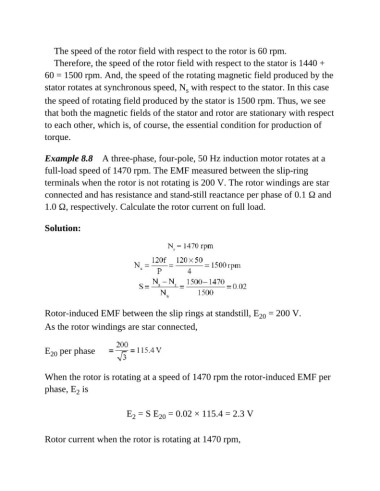
               Example 8.8    A three-phase, four-pole, 50 Hz induction motor rotates at a

               full-load speed of 1470 rpm. The EMF measured between the slip-ring
               terminals when the rotor is not rotating is 200 V. The rotor windings are star
               connected and has resistance and stand-still reactance per phase of 0.1 Ω and

               1.0 Ω, respectively. Calculate the rotor current on full load.


               Solution:


               Rotor-induced EMF between the slip rings at standstill, E  = 200 V.
                                                                                    20
               As the rotor windings are star connected,


               E  per phase
                 20


               When the rotor is rotating at a speed of 1470 rpm the rotor-induced EMF per

               phase, E  is
                          2


                                          E  = S E  = 0.02 × 115.4 = 2.3 V
                                                    20
                                            2

               Rotor current when the rotor is rotating at 1470 rpm,

