


Page 879 - Basic Electrical Engineering
P. 879
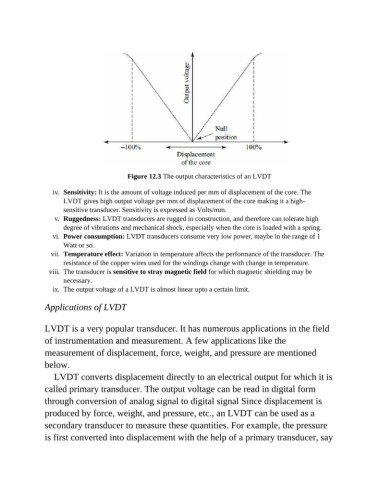
Figure 12.3 The output characteristics of an LVDT

                  iv.  Sensitivity: It is the amount of voltage induced per mm of displacement of the core. The
                     LVDT gives high output voltage per mm of displacement of the core making it a high-
                     sensitive transducer. Sensitivity is expressed as Volts/mm.
                   v.  Ruggedness: LVDT transducers are rugged in construction, and therefore can tolerate high
                     degree of vibrations and mechanical shock, especially when the core is loaded with a spring.
                  vi.  Power consumption: LVDT transducers consume very low power, maybe in the range of 1
                     Watt or so.
                 vii.  Temperature effect: Variation in temperature affects the performance of the transducer. The
                     resistance of the copper wires used for the windings change with change in temperature.
                 viii.  The transducer is sensitive to stray magnetic field for which magnetic shielding may be
                     necessary.
                  ix.  The output voltage of a LVDT is almost linear upto a certain limit.

               Applications of LVDT


               LVDT is a very popular transducer. It has numerous applications in the field
               of instrumentation and measurement. A few applications like the
               measurement of displacement, force, weight, and pressure are mentioned

               below.
                  LVDT converts displacement directly to an electrical output for which it is

               called primary transducer. The output voltage can be read in digital form
               through conversion of analog signal to digital signal Since displacement is

               produced by force, weight, and pressure, etc., an LVDT can be used as a
               secondary transducer to measure these quantities. For example, the pressure

               is first converted into displacement with the help of a primary transducer, say

