


Page 886 - Basic Electrical Engineering
P. 886
potentiometric transducers in the measurement of linear and angular
               displacement.
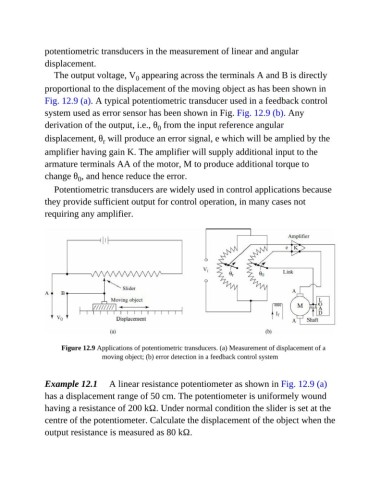
                  The output voltage, V  appearing across the terminals A and B is directly
                                             0
               proportional to the displacement of the moving object as has been shown in

               Fig. 12.9 (a). A typical potentiometric transducer used in a feedback control
               system used as error sensor has been shown in Fig. Fig. 12.9 (b). Any
               derivation of the output, i.e., θ  from the input reference angular
                                                    0
               displacement, θ  will produce an error signal, e which will be amplied by the
                                  r
               amplifier having gain K. The amplifier will supply additional input to the
               armature terminals AA of the motor, M to produce additional torque to

               change θ , and hence reduce the error.
                          0
                  Potentiometric transducers are widely used in control applications because
               they provide sufficient output for control operation, in many cases not
               requiring any amplifier.


                     Figure 12.9 Applications of potentiometric transducers. (a) Measurement of displacement of a
                                  moving object; (b) error detection in a feedback control system


               Example 12.1     A linear resistance potentiometer as shown in Fig. 12.9 (a)
               has a displacement range of 50 cm. The potentiometer is uniformely wound

               having a resistance of 200 kΩ. Under normal condition the slider is set at the
               centre of the potentiometer. Calculate the displacement of the object when the
               output resistance is measured as 80 kΩ.

