


Page 977 - Basic Electrical Engineering
P. 977
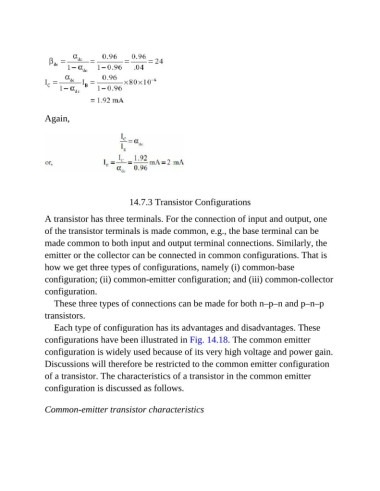
Again,


                                           14.7.3 Transistor Configurations

               A transistor has three terminals. For the connection of input and output, one

               of the transistor terminals is made common, e.g., the base terminal can be
               made common to both input and output terminal connections. Similarly, the

               emitter or the collector can be connected in common configurations. That is
               how we get three types of configurations, namely (i) common-base

               configuration; (ii) common-emitter configuration; and (iii) common-collector
               configuration.
                  These three types of connections can be made for both n–p–n and p–n–p

               transistors.
                  Each type of configuration has its advantages and disadvantages. These

               configurations have been illustrated in Fig. 14.18. The common emitter
               configuration is widely used because of its very high voltage and power gain.

               Discussions will therefore be restricted to the common emitter configuration
               of a transistor. The characteristics of a transistor in the common emitter

               configuration is discussed as follows.


               Common-emitter transistor characteristics

