


Page 14 - LHR DEC 2025.cdr
P. 14
From the
     archive


      The B-King (B for
     “Boost,” not a fast-
         food chain)


                    2007


      Suzuki B-King:


            A Tale of Over-Promise and
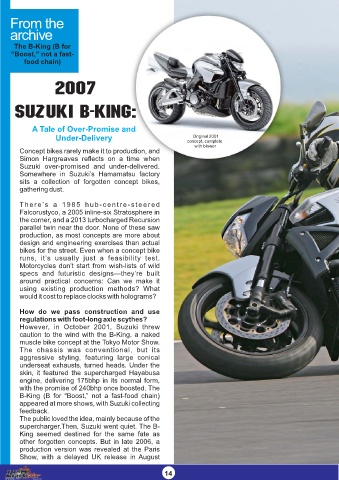
                     Under-Delivery                                  Original 2001
                                                                   concept, complete
                                                                     with blower
        Concept bikes rarely make it to production, and
        Simon  Hargreaves  reflects  on  a  time  when
        Suzuki  over-promised  and  under-delivered.
        Somewhere  in  Suzuki’s  Hamamatsu  factory
        sits  a  collection  of  forgotten  concept  bikes,
        gathering dust.

        There’s  a  1985  hub-centre-steered
        Falcorustyco, a 2005 inline-six Stratosphere in
        the corner, and a 2013 turbocharged Recursion
        parallel twin near the door. None of these saw
        production, as most concepts are more about
        design and engineering exercises than actual
        bikes for the street. Even when a concept bike
        runs,  it’s  usually  just  a  feasibility  test.
        Motorcycles don’t start from wish-lists of wild
        specs  and  futuristic  designs—they’re  built
        around  practical  concerns:  Can  we  make  it
        using  existing  production  methods?  What
        would it cost to replace clocks with holograms?


        How  do  we  pass  construction  and  use
        regulations with foot-long axle scythes?
        However,  in  October  2001,  Suzuki  threw
        caution to the wind with the B-King, a naked
        muscle bike concept at the Tokyo Motor Show.
        The  chassis  was  conventional,  but  its
        aggressive  styling,  featuring  large  conical
        underseat exhausts, turned heads. Under the
        skin,  it  featured  the  supercharged  Hayabusa
        engine, delivering 175bhp in its normal form,
        with the promise of 240bhp once boosted. The
        B-King  (B  for  “Boost,”  not  a  fast-food  chain)
        appeared at more shows, with Suzuki collecting
        feedback.
        The public loved the idea, mainly because of the
        supercharger.Then, Suzuki went quiet. The B-
        King  seemed  destined  for  the  same  fate  as
        other  forgotten  concepts.  But  in  late  2006,  a
        production version was revealed at the Paris
        Show,  with  a  delayed  UK  release  in  August

                                                           14

