


Page 17 - LHR DEC 2025.cdr
P. 17
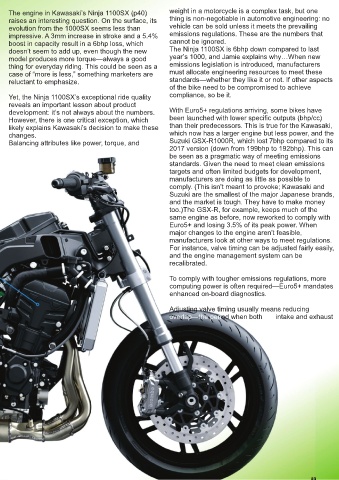
The engine in Kawasaki’s Ninja 1100SX (p40)              weight in a motorcycle is a complex task, but one
    raises an interesting question. On the surface, its      thing is non-negotiable in automotive engineering: no
    evolution from the 1000SX seems less than                vehicle can be sold unless it meets the prevailing
    impressive. A 3mm increase in stroke and a 5.4%          emissions regulations. These are the numbers that
    boost in capacity result in a 6bhp loss, which           cannot be ignored.
    doesn’t seem to add up, even though the new              The Ninja 1100SX is 6bhp down compared to last
    model produces more torque—always a good                 year’s 1000, and Jamie explains why…When new
    thing for everyday riding. This could be seen as a       emissions legislation is introduced, manufacturers
    case of “more is less,” something marketers are          must allocate engineering resources to meet these
    reluctant to emphasize.                                  standards—whether they like it or not. If other aspects
                                                             of the bike need to be compromised to achieve

    Yet, the Ninja 1100SX’s exceptional ride quality         compliance, so be it.
    reveals an important lesson about product
    development: it’s not always about the numbers.          With Euro5+ regulations arriving, some bikes have
    However, there is one critical exception, which          been launched with lower specific outputs (bhp/cc)
    likely explains Kawasaki’s decision to make these        than their predecessors. This is true for the Kawasaki,
    changes.                                                 which now has a larger engine but less power, and the
    Balancing attributes like power, torque, and             Suzuki GSX-R1000R, which lost 7bhp compared to its
                                                             2017 version (down from 199bhp to 192bhp). This can
                                                             be seen as a pragmatic way of meeting emissions
                                                             standards. Given the need to meet clean emissions
                                                             targets and often limited budgets for development,
                                                             manufacturers are doing as little as possible to
                                                             comply. (This isn’t meant to provoke; Kawasaki and
                                                             Suzuki are the smallest of the major Japanese brands,
                                                             and the market is tough. They have to make money
                                                             too.)The GSX-R, for example, keeps much of the
                                                             same engine as before, now reworked to comply with
                                                             Euro5+ and losing 3.5% of its peak power. When
                                                             major changes to the engine aren’t feasible,
                                                             manufacturers look at other ways to meet regulations.
                                                             For instance, valve timing can be adjusted fairly easily,
                                                             and the engine management system can be
                                                             recalibrated.

                                                             To comply with tougher emissions regulations, more
                                                             computing power is often required—Euro5+ mandates
                                                             enhanced on-board diagnostics.


                                                             Adjusting valve timing usually means reducing


                                                             overlap—the period when both       intake and exhaust

