


Page 18 - LHR DEC 2025.cdr
P. 18
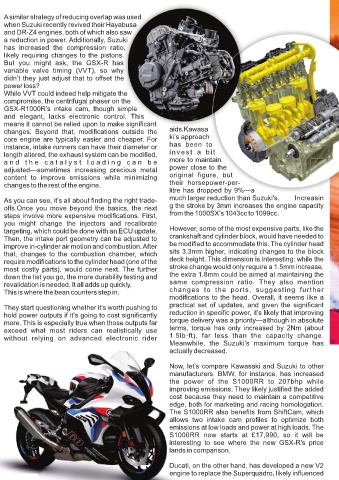
A similar strategy of reducing overlap was used
  when Suzuki recently revived their Hayabusa
  and DR-Z4 engines, both of which also saw
  a reduction in power. Additionally, Suzuki
  has  increased  the  compression  ratio,
  likely requiring changes to the pistons.
  But  you  might  ask,  the  GSX-R  has
  variable  valve  timing  (VVT),  so  why
  didn’t they just adjust that to offset the
  power loss?
  While VVT could indeed help mitigate the
  compromise, the centrifugal phaser on the
  GSX-R1000R’s  intake  cam,  though  simple
  and  elegant,  lacks  electronic  control.  This
  means it cannot be relied upon to make significant
  changes.  Beyond  that,  modifications  outside  the        aids.Kawasa
  core engine are typically easier and cheaper. For          ki’s approach
  instance, intake runners can have their diameter or        has  been  to
  length altered, the exhaust system can be modified,         invest  a  bit
  a n d   t h e   c a t a l y s t   l o a d i n g   c a n   b e   more to maintain
  adjusted—sometimes  increasing  precious  metal            power close to the
  content  to  improve  emissions  while  minimizing         original  figure,  but
  changes to the rest of the engine.                         their  horsepower-per-
                                                             litre has dropped by 9%—a
                                                             much larger reduction than Suzuki's.        Increasin
  As you can see, it’s all about finding the right trade-
  offs.Once  you  move  beyond  the  basics,  the  next       g the stroke by 3mm increases the engine capacity
  steps involve more expensive modifications. First,          from the 1000SX’s 1043cc to 1099cc.
  you  might  change  the  injectors  and  recalibrate
  targeting, which could be done with an ECU update.         However, some of the most expensive parts, like the
  Then, the intake port geometry can be adjusted to          crankshaft and cylinder block, would have needed to
  improve in-cylinder air motion and combustion. After       be modified to accommodate this. The cylinder head
  that,  changes  to  the  combustion  chamber,  which       sits 3.3mm higher, indicating changes to the block
  require modifications to the cylinder head (one of the      deck height. This dimension is interesting: while the
  most  costly  parts),  would  come  next. The  further     stroke change would only require a 1.5mm increase,
  down the list you go, the more durability testing and      the extra 1.8mm could be aimed at maintaining the
  revalidation is needed. It all adds up quickly.            same  compression  ratio.  They  also  mention
  This is where the bean counters step in.                   changes  to  the  ports,  suggesting  further
                                                             modifications to the head. Overall, it seems like a
                                                             practical set of updates, and given the significant
  They start questioning whether it’s worth pushing to
  hold power outputs if it’s going to cost significantly      reduction in specific power, it’s likely that improving
  more. This is especially true when those outputs far       torque delivery was a priority—although in absolute
  exceed  what  most  riders  can  realistically  use        terms,  torque  has  only  increased  by  2Nm  (about
  without  relying  on  advanced  electronic  rider          1.5lb·ft),  far  less  than  the  capacity  change.
                                                             Meanwhile,  the  Suzuki's  maximum  torque  has
                                                             actually decreased.


                                                             Now, let’s compare Kawasaki and Suzuki to other
                                                             manufacturers. BMW, for instance, has increased
                                                             the  power  of  the  S1000RR  to  207bhp  while
                                                             improving emissions. They likely justified the added
                                                             cost because they need to maintain a competitive
                                                             edge, both for marketing and racing homologation.
                                                             The S1000RR also benefits from ShiftCam, which
                                                             allows  two  intake  cam  profiles  to  optimize  both
                                                             emissions at low loads and power at high loads. The
                                                             S1000RR  now  starts  at  £17,990,  so  it  will  be
                                                             interesting  to  see  where  the  new  GSX-R's  price
                                                             lands in comparison.


                                                             Ducati, on the other hand, has developed a new V2
                                                             engine to replace the Superquadro, likely influenced

