


Page 31 - Computer Graphics Handout
P. 31
This step requires a tremendous amount of computation, so we might prefer to use a  render farm, a cluster of computers configured
          for numerical computing. Not only is the optimal hardware different in the modeling and rendering steps, but the software that we
          use also may be different. The interface between the modeler and renderer can be as simple as a file produced by the modeler that
          describes the objects and that contains additional information important only to the renderer, such as light sources, viewer location,
          and material properties. Pixar’s Renderman Interface follows this approach and uses a file format that allows modelers to pass
          models to the renderer in text format. One of the other advantages of this approach is that it allows us to develop modelers that,
          although they use the same renderer, are custom-tailored to particular applications. Likewise, different renderers can take as input
          the same interface file. It is even possible, at least in principle, to dispense with the odeler completely and to use a standard text
          editor to generate an interface file. For any but the simplest scenes, however, users cannot edit lists of information for a renderer.
          Rather, they use interactive modeling software. Because we must have at least a simple image of our objects to interact with a
          modeler, most modelers use the synthetic-camera model to produce these images in real time. This paradigm has become popular
          as a method for generating computer games and images over the Internet. Models, including the geometric objects, lights, cameras,
          and material properties, are placed in a data structure called a scene graph that is passed to a renderer or game engine. We shall
          examine scene graphs in Chapter 8.


          1.7 GRAPHICS ARCHITECTURES


          On one side of the API is the application program. On the other is some combination of hardware and software that implements the
          functionality of the API. Researchers have taken various approaches to developing architectures to support graphics APIs. Early
          graphics systems used general-purpose computers with the standard von Neumann architecture. Such computers are characterized
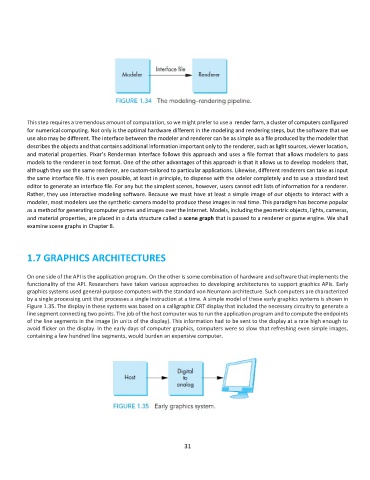
          by a single processing unit that processes a single instruction at a time. A simple model of these early graphics systems is shown in
          Figure 1.35. The display in these systems was based on a calligraphic CRT display that included the necessary circuitry to generate a
          line segment connecting two points. The job of the host computer was to run the application program and to compute the endpoints
          of the line segments in the image (in units of the display). This information had to be sent to the display at a rate high enough to
          avoid flicker on the display. In the early days of computer graphics, computers were so slow that refreshing even simple images,
          containing a few hundred line segments, would burden an expensive computer.


                                                              31

