


Page 27 - Computer Graphics Handout
P. 27
We can describe such a graphics system with two drawing functions:
          moveto(x,y);
          lineto(x,y);
          Execution of the moveto function moves the pen to the location (x, y) on the paper without leaving a mark. The lineto function
          moves the pen to (x, y) and draws a line from the old to the new location of the pen. Once we add a few initialization and termination
          procedures, as well as the ability to change pens to alter the drawing color or line thickness, we have a simple—but complete—
          graphics system. Here is a fragment of a simple program in such a system:
          moveto(0, 0);
          lineto(1, 0);
          lineto(1, 1);
          lineto(0, 1);
          lineto(0, 0);
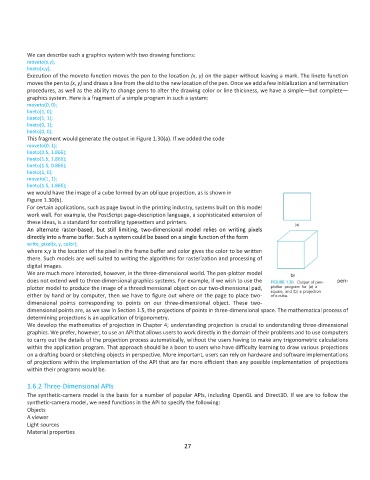
          This fragment would generate the output in Figure 1.30(a). If we added the code
          moveto(0, 1);
          lineto(0.5, 1.866);
          lineto(1.5, 1.866);
          lineto(1.5, 0.866);
          lineto(1, 0);
          moveto(1, 1);
          lineto(1.5, 1.866);
          we would have the image of a cube formed by an oblique projection, as is shown in
          Figure 1.30(b).
          For certain applications, such as page layout in the printing industry, systems built on this model
          work well. For example, the PostScript page-description language, a sophisticated extension of
          these ideas, is a standard for controlling typesetters and printers.
          An  alternate  raster-based,  but  still  limiting,  two-dimensional  model  relies  on  writing  pixels
          directly into a frame buffer. Such a system could be based on a single function of the form
          write_pixel(x, y, color);
          where x,y is the location of the pixel in the frame buffer and color gives the color to be written
          there. Such models are well suited to writing the algorithms for rasterization and processing of
          digital images.
          We are much more interested, however, in the three-dimensional world. The pen-plotter model
          does not extend well to three-dimensional graphics systems. For example, if we wish to use the         pen-
          plotter model to produce the image of a threedimensional object on our two-dimensional pad,
          either by hand or by computer, then we have to figure out where on the page to place two-
          dimensional  points  corresponding  to  points  on  our  three-dimensional  object.  These  two-
          dimensional points are, as we saw in Section 1.5, the projections of points in three-dimensional space. The mathematical process of
          determining projections is an application of trigonometry.
          We develop the mathematics of projection in Chapter 4; understanding projection is crucial to understanding three-dimensional
          graphics. We prefer, however, to use an API that allows users to work directly in the domain of their problems and to use computers
          to carry out the details of the projection process automatically, without the users having to make any trigonometric calculations
          within the application program. That approach should be a boon to users who have difficulty learning to draw various projections
          on a drafting board or sketching objects in perspective. More important, users can rely on hardware and software implementations
          of projections within the implementation of the API that are far more efficient than any possible implementation of projections
          within their programs would be.

          1.6.2 Three-Dimensional APIs
          The synthetic-camera model is the basis for a number of popular APIs, including OpenGL and Direct3D. If we are to follow the
          synthetic-camera model, we need functions in the API to specify the following:
          Objects
          A viewer
          Light sources
          Material properties

                                                              27

