


Page 32 - Computer Graphics Handout
P. 32
1.7.1 Display Processors
          The  earliest  attempts  to  build  special-purpose  graphics  systems  were  concerned  primarily  with  relieving  the  general-purpose
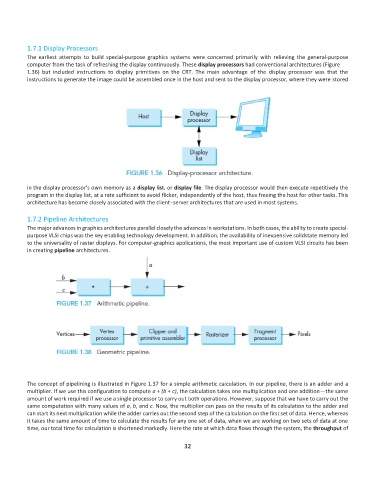
          computer from the task of refreshing the display continuously. These display processors had conventional architectures (Figure
          1.36)  but  included  instructions  to  display  primitives  on  the  CRT.  The  main  advantage  of  the  display  processor  was  that  the
          instructions to generate the image could be assembled once in the host and sent to the display processor, where they were stored


          in the display processor’s own memory as a display list, or display file. The display processor would then execute repetitively the
          program in the display list, at a rate sufficient to avoid flicker, independently of the host, thus freeing the host for other tasks. This
          architecture has become closely associated with the client–server architectures that are used in most systems.

          1.7.2 Pipeline Architectures
          The major advances in graphics architectures parallel closely the advances in workstations. In both cases, the ability to create special-
          purpose VLSI chips was the key enabling technology development. In addition, the availability of inexpensive solidstate memory led
          to the universality of raster displays. For computer-graphics applications, the most important use of custom VLSI circuits has been
          in creating pipeline architectures.


          The concept of pipelining is illustrated in Figure 1.37 for a simple arithmetic calculation. In our pipeline, there is an adder and a
          multiplier. If we use this configuration to compute a + (b ∗ c), the calculation takes one multiplication and one addition—the same
          amount of work required if we use a single processor to carry out both operations. However, suppose that we have to carry out the
          same computation with many values of a, b, and c. Now, the multiplier can pass on the results of its calculation to the adder and
          can start its next multiplication while the adder carries out the second step of the calculation on the first set of data. Hence, whereas
          it takes the same amount of time to calculate the results for any one set of data, when we are working on two sets of data at one
          time, our total time for calculation is shortened markedly. Here the rate at which data flows through the system, the throughput of

                                                              32

