


Page 23 - Computer Graphics Handout
P. 23
equivalent to choosing d for the pinhole camera—we can achieve any desired angle of view (up to 180 degrees). Lenses, however,
          do not have an infinite depth of field: Not all distances from the lens are in focus. For our purposes, in this chapter we can work with
          a pinhole camera whose focal length is the distance d from the front of the camera to the film plane. Like the pinhole camera,
          computer graphics produces images in which all objects are in focus.

          1.4.2 The Human Visual System
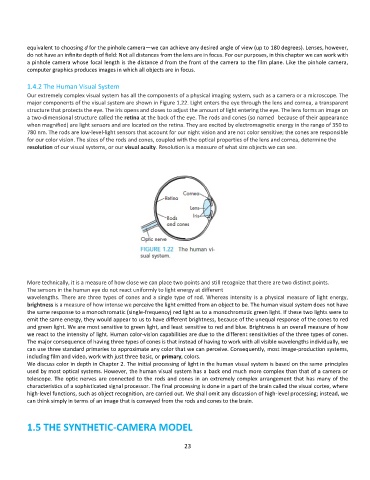
          Our extremely complex visual system has all the components of a physical imaging system, such as a camera or a microscope. The
          major components of the visual system are shown in Figure 1.22. Light enters the eye through the lens and cornea, a transparent
          structure that protects the eye. The iris opens and closes to adjust the amount of light entering the eye. The lens forms an image on
          a two-dimensional structure called the retina at the back of the eye. The rods and cones (so named  because of their appearance
          when magnified) are light sensors and are located on the retina. They are excited by electromagnetic energy in the range of 350 to
          780 nm. The rods are low-level-light sensors that account for our night vision and are not color sensitive; the cones are responsible
          for our color vision. The sizes of the rods and cones, coupled with the optical properties of the lens and cornea, determine the
          resolution of our visual systems, or our visual acuity. Resolution is a measure of what size objects we can see.


          More technically, it is a measure of how close we can place two points and still recognize that there are two distinct points.
          The sensors in the human eye do not react uniformly to light energy at different
          wavelengths. There are three types of cones and a single type of rod. Whereas intensity is a physical measure of light energy,
          brightness is a measure of how intense we perceive the light emitted from an object to be. The human visual system does not have
          the same response to a monochromatic (single-frequency) red light as to a monochromatic green light. If these two lights were to
          emit the same energy, they would appear to us to have different brightness, because of the unequal response of the cones to red
          and green light. We are most sensitive to green light, and least sensitive to red and blue. Brightness is an overall measure of how
          we react to the intensity of light. Human color-vision capabilities are due to the different sensitivities of the three types of cones.
          The major consequence of having three types of cones is that instead of having to work with all visible wavelengths individually, we
          can use three standard primaries to approximate any color that we can perceive. Consequently, most image-production systems,
          including film and video, work with just three basic, or primary, colors.
          We discuss color in depth in Chapter 2. The initial processing of light in the human visual system is based on the same principles
          used by most optical systems. However, the human visual system has a back end much more complex than that of a camera or
          telescope. The optic nerves are connected to the rods and cones in an extremely complex arrangement that has many of the
          characteristics of a sophisticated signal processor. The final processing is done in a part of the brain called the visual cortex, where
          high-level functions, such as object recognition, are carried out. We shall omit any discussion of high-level processing; instead, we
          can think simply in terms of an image that is conveyed from the rods and cones to the brain.


          1.5 THE SYNTHETIC-CAMERA MODEL


                                                              23

