


Page 21 - Computer Graphics Handout
P. 21
the camera and strike the film plane. Most rays, however, go off to infinity, neither entering the camera directly nor striking any of
          the objects. These rays contribute nothing to the image, although they may be seen by some other viewer. The remaining rays strike
          and illuminate objects. These rays can interact with the objects’ surfaces in a variety of ways. For example, if the surface is a mirror,
          a reflected ray might—depending on the orientation of the surface—enter the lens of the camera and contribute to the image.
          Other surfaces scatter light in all directions. If the surface is transparent, the light ray from the source can pass through it and may
          interact with other objects, enter the camera, or travel to infinity without striking another surface. Figure 1.18 shows some of the
          possibilities.


          Ray tracing and photonmapping are image-formation techniques that are based on these ideas and that can formthe basis for
          producing computer-generated images. We can use the ray-tracing idea to simulate physical effects as complex as we wish, as long
          as we are willing to carry out the requisite computing. Although tracing rays can provide a close approximation to the physical world,
          it is usually not well suited for real-time computation.
          Other physical approaches to image formation are based on conservation of energy. The most important in computer graphics is
          radiosity. This method works best for surfaces that scatter the incoming light equally in all directions. Even in this case, radiosity
          requires more computation than can be done in real time. We defer discussion of these techniques until Chapter 11.


          1.4 IMAGING SYSTEMS


          We now introduce two imaging systems: the pinhole camera and the human visual system. The pinhole camera is a simple example
          of an imaging system that will enable us to understand the functioning of cameras and of other optical imagers. We emulate it to
          build a model of image formation. The human visual system is extremely complex but still obeys the physical principles of other
          optical imaging systems. We introduce it not only as an example of an imaging system but also because understanding its properties
          will help us to exploit the capabilities of computer-graphics systems.

          1.4.1 The Pinhole Camera
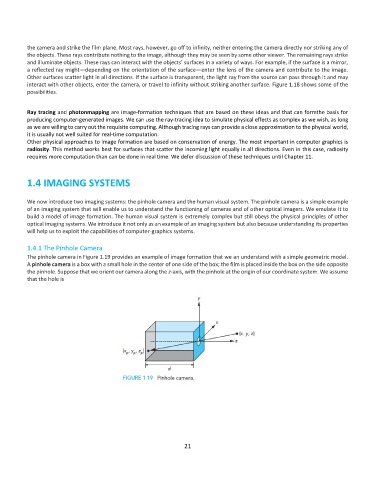
          The pinhole camera in Figure 1.19 provides an example of image formation that we an understand with a simple geometric model.
          A pinhole camera is a box with a small hole in the center of one side of the box; the film is placed inside the box on the side opposite
          the pinhole. Suppose that we orient our camera along the z-axis, with the pinhole at the origin of our coordinate system. We assume
          that the hole is


                                                              21

