


Page 19 - Computer Graphics Handout
P. 19
Every  imaging  system  must  provide  a  means  of  forming  images  from  objects.  To  form  an  image,  we  must  have  someone  or
          something that is viewing our objects, be it a human, a camera, or a digitizer. It is the viewer that forms the image of our objects.
          In the human visual system, the image is formed on the back of the eye. In a camera, the image is formed in the film plane. It is easy
          to confuse images and objects. We usually see an object from our single perspective and forget that
          other viewers, located in other places, will see the same object differently. Figure 1.13(a) shows two
          viewers observing the same building. This image is what is seen by an observer A who is far enough away
          from the building to see both the building and the two other viewers, B and C. From A’s perspective, B
          and C appear as objects, just as the building does. Figures 1.13(b) and (c) show the images seen by B and
          C, respectively. All three images contain the same building, but the image of the building is different in
          all three.
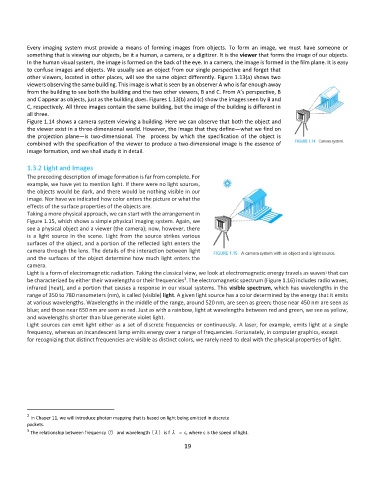
          Figure 1.14 shows a camera system viewing a building. Here we can observe that both the object and
          the viewer exist in a three-dimensional world. However, the image that they define—what we find on
          the  projection  plane—is  two-dimensional.  The    process  by  which  the  specification  of  the  object  is
          combined with the specification of the viewer to produce a two-dimensional image is the essence of
          image formation, and we shall study it in detail.

          1.3.2 Light and Images
          The preceding description of image formation is far from complete. For
          example, we have yet to mention light. If there were no light sources,
          the objects would be dark, and there would be nothing visible in our
          image. Nor have we indicated how color enters the picture or what the
          effects of the surface properties of the objects are.
          Taking a more physical approach, we can start with the arrangement in
          Figure 1.15, which shows a simple physical imaging system. Again, we
          see a physical object and a viewer (the camera); now, however, there
          is  a  light  source  in  the  scene.  Light  from  the  source  strikes  various
          surfaces of the object, and a portion of the reflected light enters the
          camera through the lens. The details of the interaction between light
          and the surfaces of the object determine how much light enters the
          camera.
          Light is a form of electromagnetic radiation. Taking the classical view, we look at electromagnetic energy travels as waves  that can
                                                                                                             2
                                                              3
          be characterized by either their wavelengths or their frequencies . The electromagnetic spectrum (Figure 1.16) includes radio waves,
          infrared (heat), and a portion that causes a response in our visual systems. This visible spectrum, which has wavelengths in the
          range of 350 to 780 nanometers (nm), is called (visible) light. A given light source has a color determined by the energy that it emits
          at various wavelengths. Wavelengths in the middle of the range, around 520 nm, are seen as green; those near 450 nm are seen as
          blue; and those near 650 nm are seen as red. Just as with a rainbow, light at wavelengths between red and green, we see as yellow,
          and wavelengths shorter than blue generate violet light.
          Light sources can emit light either as a set of discrete frequencies or continuously. A laser, for example, emits light at a single
          frequency, whereas an incandescent lamp emits energy over a range of frequencies. Fortunately, in computer graphics, except
          for recognizing that distinct frequencies are visible as distinct colors, we rarely need to deal with the physical properties of light.


          2
            In Chaper 11, we will introduce photon mapping that is based on light being emitted in discrete
          packets.
          3  The relationship between frequency (f) and wavelength (λ) is f λ = c, where c is the speed of light.

                                                              19

