


Page 18 - Computer Graphics Handout
P. 18
however, we want to exploit the capabilities of the software and hardware to create realistic images of computer-generated three-
          dimensional objects—a task that involves many aspects of image formation, such as lighting, shading, and properties of materials.
          Because such functionality is supported directly by most present computer graphics systems, we prefer to set the stage for creating
          these images here, rather than to expand a limited model later.
          Computer-generated images are synthetic or artificial, in the sense that the objects being imaged do not exist physically. In this
          chapter, we argue that the preferred method to form computer-generated images is similar to traditional imaging methods, such
          as cameras and the human visual system. Hence, before we discuss the mechanics of writing programs to generate images, we
          discuss the way images are formed by optical systems. We construct a model of the image-formation process that we can then use
          to understand and develop computer-generated imaging systems.
          In this chapter, we make minimal use of mathematics. We want to establish a paradigm for creating images and to present a
          computer architecture for implementing that paradigm. Details are presented in subsequent chapters, where we shall derive the
          relevant equations.

          1.3.1 Objects and Viewers
          We live in a world of three-dimensional objects. The development of many branches of mathematics, including geometry and
          trigonometry, was in response to the desire to systematize conceptually simple ideas, such as the measurement of size of objects
          and distance between objects. Often, we seek to represent our understanding of such spatial relationships with pictures or images,
          such as maps, paintings,and photographs. Likewise, the development of many physical devices—including cameras, microscopes,
          and telescopes—was tied to the desire to visualize spatial relationships among objects.
          Hence, there always has been a fundamental link between the physics and the mathematics of image formation—one that we can
          exploit in our development of computer image formation. Two basic entities must be part of any image-formation process, be it
          mathematical or physical: object and viewer. The object exists in space independent of any image-formation process and of any
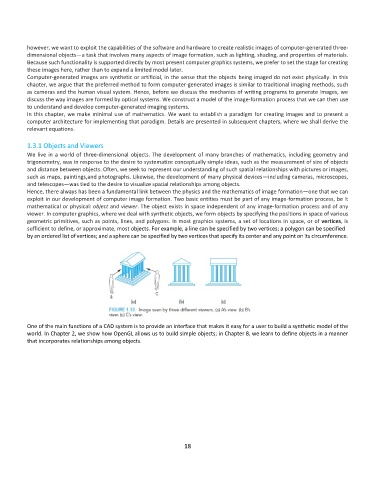
          viewer. In computer graphics, where we deal with synthetic objects, we form objects by specifying the positions in space of various
          geometric primitives, such as points, lines, and polygons. In most graphics systems, a set of locations in space, or of vertices, is
          sufficient to define, or approximate, most objects. For example, a line can be specified by two vertices; a polygon can be specified
          by an ordered list of vertices; and a sphere can be specified by two vertices that specify its center and any point on its circumference.


          One of the main functions of a CAD system is to provide an interface that makes it easy for a user to build a synthetic model of the
          world. In Chapter 2, we show how OpenGL allows us to build simple objects; in Chapter 8, we learn to define objects in a manner
          that incorporates relationships among objects.


                                                              18

