


Page 13 - Computer Graphics Handout
P. 13
CPU. Today, virtually all graphics systems are characterized by special-purpose graphics processing units (GPUs), custom-tailored
          to carry out specific graphics functions. The GPU can be either on the mother board of the system or on a graphics card. The frame
          buffer is accessed through the graphics processing unit and usually is on the same circuit board as the GPU.
          GPUs have evolved to where they are as complex or even more complex than CPUs. They are characterized by both special-purpose
          modules geared toward graphical operations and a high degree of parallelism—recent GPUs contain over 100 processing units, each
          of which is user programmable. GPUs are so powerful that they can often be used as mini supercomputers for general purpose
          computing. We will discuss GPU architectures in more detail in Section 1.7.

          1.2.3 Output Devices
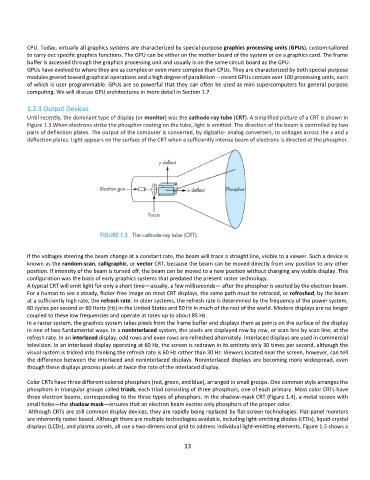
          Until recently, the dominant type of display (or monitor) was the cathode-ray tube (CRT). A simplified picture of a CRT is shown in
          Figure 1.3.When electrons strike the phosphor coating on the tube, light is emitted. The direction of the beam is controlled by two
          pairs of deflection plates. The output of the computer is converted, by digitalto- analog converters, to voltages across the x and y
          deflection plates. Light appears on the surface of the CRT when a sufficiently intense beam of electrons is directed at the phosphor.


          If the voltages steering the beam change at a constant rate, the beam will trace a straight line, visible to a viewer. Such a device is
          known as the random-scan, calligraphic, or vector CRT, because the beam can be moved directly from any position to any other
          position. If intensity of the beam is turned off, the beam can be moved to a new position without changing any visible display. This
          configuration was the basis of early graphics systems that predated the present raster technology.
          A typical CRT will emit light for only a short time—usually, a few milliseconds— after the phosphor is excited by the electron beam.
          For a human to see a steady, flicker-free image on most CRT displays, the same path must be retraced, or refreshed, by the beam
          at a sufficiently high rate, the refresh rate. In older systems, the refresh rate is determined by the frequency of the power system,
          60 cycles per second or 60 Hertz (Hz) in the United States and 50 Hz in much of the rest of the world. Modern displays are no longer
          coupled to these low frequencies and operate at rates up to about 85 Hz.
          In a raster system, the graphics system takes pixels from the frame buffer and displays them as points on the surface of the display
          in one of two fundamental ways. In a noninterlaced system, the pixels are displayed row by row, or scan line by scan line, at the
          refresh rate. In an interlaced display, odd rows and even rows are refreshed alternately. Interlaced displays are used in commercial
          television. In an interlaced display operating at 60 Hz, the screen is redrawn in its entirety only 30 times per second, although the
          visual system is tricked into thinking the refresh rate is 60 Hz rather than 30 Hz. Viewers located near the screen, however, can tell
          the difference between the interlaced and noninterlaced displays. Noninterlaced displays are becoming more widespread, even
          though these displays process pixels at twice the rate of the interlaced display.

          Color CRTs have three different colored phosphors (red, green, and blue), arranged in small groups. One common style arranges the
          phosphors in triangular groups called triads, each triad consisting of three phosphors, one of each primary. Most color CRTs have
          three electron beams, corresponding to the three types of phosphors. In the shadow-mask CRT (Figure 1.4), a metal screen with
          small holes—the shadow mask—ensures that an electron beam excites only phosphors of the proper color.
           Although CRTs are still common display devices, they are rapidly being replaced by flat-screen technologies. Flat-panel monitors
          are inherently raster based. Although there are multiple technologies available, including light-emitting diodes (LEDs), liquid-crystal
          displays (LCDs), and plasma panels, all use a two-dimensional grid to address individual light-emitting elements. Figure 1.5 shows a


                                                              13

