


Page 16 - Computer Graphics Handout
P. 16
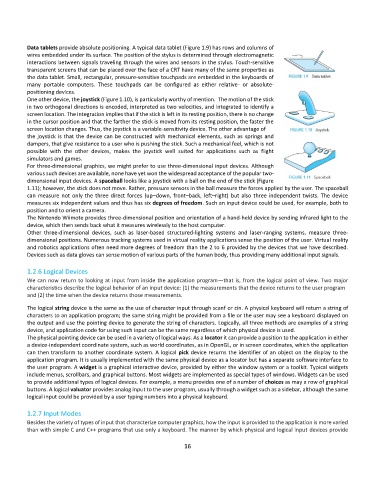
Data tablets provide absolute positioning. A typical data tablet (Figure 1.9) has rows and columns of
          wires embedded under its surface. The position of the stylus is determined through electromagnetic
          interactions between signals traveling through the wires and sensors in the stylus. Touch-sensitive
          transparent screens that can be placed over the face of a CRT have many of the same properties as
          the data tablet. Small, rectangular, pressure-sensitive touchpads are embedded in the keyboards of
          many  portable  computers.  These  touchpads  can  be  configured  as  either  relative-  or  absolute-
          positioning devices.
          One other device, the joystick (Figure 1.10), is particularly worthy of mention.  The motion of the stick
          in two orthogonal directions is encoded, interpreted as two velocities, and integrated to identify a
          screen location. The integration implies that if the stick is left in its resting position, there is no change
          in the cursor position and that the farther the stick is moved from its resting position, the faster the
          screen location changes. Thus, the joystick is a variable-sensitivity device. The other advantage of
          the joystick is that the device can be constructed with mechanical elements, such as springs and
          dampers, that give resistance to a user who is pushing the stick. Such a mechanical feel, which is not
          possible  with  the  other  devices,  makes  the  joystick  well  suited  for  applications  such  as  flight
          simulators and games.
          For three-dimensional graphics, we might prefer to use three-dimensional input devices. Although
          various such devices are available, none have yet won the widespread acceptance of the popular two-
          dimensional input devices. A spaceball looks like a joystick with a ball on the end of the stick (Figure
          1.11); however, the stick does not move. Rather, pressure sensors in the ball measure the forces applied by the user. The spaceball
          can measure not only the three direct forces (up–down, front–back, left–right) but also three independent twists. The device
          measures six independent values and thus has six degrees of freedom. Such an input device could be used, for example, both to
          position and to orient a camera.
          The Nintendo Wiimote provides three-dimensional position and orientation of a hand-held device by sending infrared light to the
          device, which then sends back what it measures wirelessly to the host computer.
          Other  three-dimensional  devices,  such  as  laser-based  structured-lighting  systems  and  laser-ranging  systems,  measure  three-
          dimensional positions. Numerous tracking systems used in virtual reality applications sense the position of the user. Virtual reality
          and robotics applications often need more degrees of freedom than the 2 to 6 provided by the devices that we have described.
          Devices such as data gloves can sense motion of various parts of the human body, thus providing many additional input signals.

          1.2.6 Logical Devices
          We can now return to looking at input from inside the application program—that is, from the logical point of view. Two major
          characteristics describe the logical behavior of an input device: (1) the measurements that the device returns to the user program
          and (2) the time when the device returns those measurements.

          The logical string device is the same as the use of character input through scanf or cin. A physical keyboard will return a string of
          characters to an application program; the same string might be provided from a file or the user may see a keyboard displayed on
          the output and use the pointing device to generate the string of characters. Logically, all three methods are examples of a string
          device, and application code for using such input can be the same regardless of which physical device is used.
          The physical pointing device can be used in a variety of logical ways. As a locator it can provide a position to the application in either
          a device-independent coordinate system, such as world coordinates, as in OpenGL, or in screen coordinates, which the application
          can then transform to another coordinate system. A logical pick device returns the identifier of an object on the display to the
          application program. It is usually implemented with the same physical device as a locator but has a separate software interface to
          the user program. A widget is a graphical interactive device, provided by either the window system or a toolkit. Typical widgets
          include menus, scrollbars, and graphical buttons. Most widgets are implemented as special types of windows. Widgets can be used
          to provide additional types of logical devices. For example, a menu provides one of a number of choices as may a row of graphical
          buttons. A logical valuator provides analog input to the user program, usually through a widget such as a sidebar, although the same
          logical input could be provided by a user typing numbers into a physical keyboard.

          1.2.7 Input Modes
          Besides the variety of types of input that characterize computer graphics, how the input is provided to the application is more varied
          than with simple C and C++ programs that use only a keyboard. The manner by which physical and logical input devices provide

                                                              16

