


Page 20 - Computer Graphics Handout
P. 20
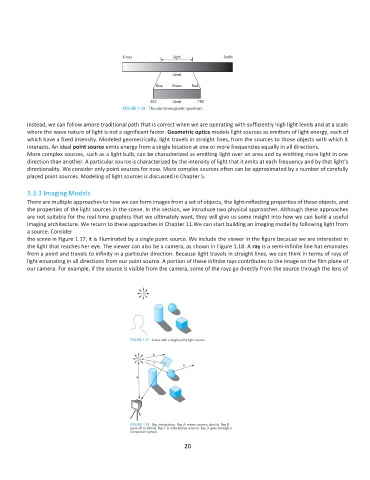
Instead, we can follow amore traditional path that is correct when we are operating with sufficiently high light levels and at a scale
          where the wave nature of light is not a significant factor. Geometric optics models light sources as emitters of light energy, each of
          which have a fixed intensity. Modeled geometrically, light travels in straight lines, from the sources to those objects with which it
          interacts. An ideal point source emits energy from a single location at one or more frequencies equally in all directions.
          More complex sources, such as a light bulb, can be characterized as emitting light over an area and by emitting more light in one
          direction than another. A particular source is characterized by the intensity of light that it emits at each frequency and by that light’s
          directionality. We consider only point sources for now. More complex sources often can be approximated by a number of carefully
          placed point sources. Modeling of light sources is discussed in Chapter 5.

          1.3.3 Imaging Models
          There are multiple approaches to how we can form images from a set of objects, the light-reflecting properties of these objects, and
          the properties of the light sources in the scene. In this section, we introduce two physical approaches. Although these approaches
          are not suitable for the real-time graphics that we ultimately want, they will give us some insight into how we can build a useful
          imaging architecture. We return to these approaches in Chapter 11.We can start building an imaging model by following light from
          a source. Consider
          the scene in Figure 1.17; it is illuminated by a single point source. We include the viewer in the figure because we are interested in
          the light that reaches her eye. The viewer can also be a camera, as shown in Figure 1.18. A ray is a semi-infinite line hat emanates
          from a point and travels to infinity in a particular direction. Because light travels in straight lines, we can think in terms of rays of
          light emanating in all directions from our point source. A portion of these infinite rays contributes to the image on the film plane of
          our camera. For example, if the source is visible from the camera, some of the rays go directly from the source through the lens of


                                                              20

