


Page 17 - Computer Graphics Handout
P. 17
input to an application program can be described in terms of two entities: a measure process and a device trigger. The measure of
          a device is what the device returns to the user program. The trigger of a device is a physical input on the device with which the user
          can signal the computer. For example, the measure of a keyboard contains a string, and the trigger can be the Return or Enter key.
          For a locator, the measure includes the position, and the associated trigger can be a button on the pointing device.
          We can obtain the measure of a device in three distinct modes. Each mode is defined by the relationship between the measure
          process and the trigger. Once the measure process is started, the measure is taken and placed in a buffer, even though the contents
          of the buffer may not yet be available to the program. For example, the position of a mouse is tracked continuously by the underlying
          window system, regardless of whether the application program needs mouse input.
          In request mode, the measure of the device is not returned to the program until the device is triggered. This input mode is standard
          in nongraphical applications. For example, if a typical C program requires character input, we use a function such as scanf. When
          the program needs the input, it halts when it encounters the scanf statement and waits while we type characters at our terminal.
          We can backspace to correct our typing, and we can take as long as we like. The data are placed in a keyboard buffer, whose contents
          are returned to our program only after a particular key, such as the Enter key (the trigger), is depressed. For a logical device, such
          as a locator, we can move our pointing device to the desired location and then trigger the device with its button; the trigger will
          cause the location to be returned to the application program. Sample-mode input is immediate. As soon as the function call in the
          application program is encountered, the measure is returned. In sample mode, the user must have positioned the pointing device
          or entered data using the keyboard before the function call, because the measure is extracted immediately from the buffer. One
          characteristic of both request- and sample-mode input in APIs that support them is that the user must identify which device is to
          provide the input. Consequently, we ignore any other information that becomes available from any input device other than the one
          specified. Both request and sample modes are useful for situations where the program guides the user, but they are not useful in
          applications where the user controls the flow of the program. For example, a flight simulator or computer game might have multiple
          input devices—such as a joystick, dials, buttons, and switches— most of which can be used at any time. Writing programs to control
          the simulator with only sample- and request-mode input is nearly impossible, because we do not know what devices the pilot will
          use at any point in the simulation. More generally, sample- and request-mode input are not sufficient for handling the variety of
          possible human–computer interactions that arise in a modern computing environment.
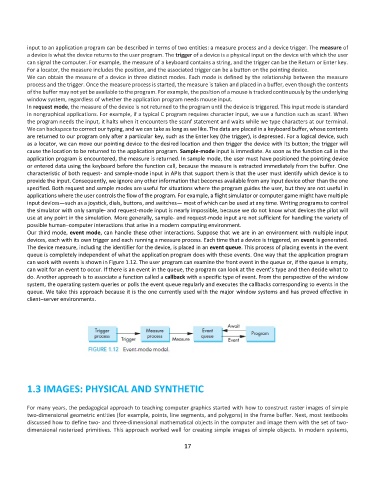
          Our third mode, event mode, can handle these other interactions. Suppose that we are in an environment with multiple input
          devices, each with its own trigger and each running a measure process. Each time that a device is triggered, an event is generated.
          The device measure, including the identifier for the device, is placed in an event queue. This process of placing events in the event
          queue is completely independent of what the application program does with these events. One way that the application program
          can work with events is shown in Figure 1.12. The user program can examine the front event in the queue or, if the queue is empty,
          can wait for an event to occur. If there is an event in the queue, the program can look at the event’s type and then decide what to
          do. Another approach is to associate a function called a callback with a specific type of event. From the perspective of the window
          system, the operating system queries or polls the event queue regularly and executes the callbacks corresponding to events in the
          queue. We take this approach because it is the one currently used with the major window systems and has proved effective in
          client–server environments.


          1.3 IMAGES: PHYSICAL AND SYNTHETIC


          For many years, the pedagogical approach to teaching computer graphics started with how to construct raster images of simple
          two-dimensional geometric entities (for example, points, line segments, and polygons) in the frame buffer. Next, most textbooks
          discussed how to define two- and three-dimensional mathematical objects in the computer and image them with the set of two-
          dimensional rasterized primitives. This approach worked well for creating simple images of simple objects. In modern systems,

                                                              17

