


Page 12 - Computer Graphics Handout
P. 12
Central       Graphics


                                       CPU           GPU
                                                    Memory


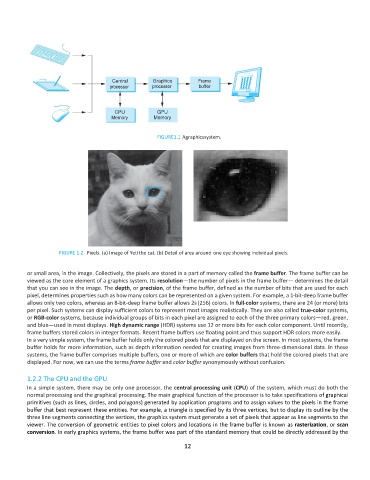
                                                     FIGURE 1.1 A graphics system.


                     FIGURE 1.2   Pixels. (a) Image of Yeti the cat. (b) Detail of area around one eye showing individual pixels.


          or small area, in the image. Collectively, the pixels are stored in a part of memory called the frame buffer. The frame buffer can be
          viewed as the core element of a graphics system. Its resolution—the number of pixels in the frame buffer— determines the detail
          that you can see in the image. The depth, or precision, of the frame buffer, defined as the number of bits that are used for each
          pixel, determines properties such as how many colors can be represented on a given system. For example, a 1-bit-deep frame buffer
          allows only two colors, whereas an 8-bit-deep frame buffer allows 28 (256) colors. In full-color systems, there are 24 (or more) bits
          per pixel. Such systems can display sufficient colors to represent most images realistically. They are also called true-color systems,
          or RGB-color systems, because individual groups of bits in each pixel are assigned to each of the three primary colors—red, green,
          and blue—used in most displays. High dynamic range (HDR) systems use 12 or more bits for each color component. Until recently,
          frame buffers stored colors in integer formats. Recent frame buffers use floating point and thus support HDR colors more easily.
          In a very simple system, the frame buffer holds only the colored pixels that are displayed on the screen. In most systems, the frame
          buffer holds far more information, such as depth information needed for creating images from three-dimensional data. In these
          systems, the frame buffer comprises multiple buffers, one or more of which are color buffers that hold the colored pixels that are
          displayed. For now, we can use the terms frame buffer and color buffer synonymously without confusion.

          1.2.2 The CPU and the GPU
          In a simple system, there may be only one processor, the central processing unit (CPU) of the system, which must do both the
          normal processing and the graphical processing. The main graphical function of the processor is to take specifications of graphical
          primitives (such as lines, circles, and polygons) generated by application programs and to assign values to the pixels in the frame
          buffer that best represent these entities. For example, a triangle is specified by its three vertices, but to display its outline by the
          three line segments connecting the vertices, the graphics system must generate a set of pixels that appear as line segments to the
          viewer. The conversion of geometric entities to pixel colors and locations in the frame buffer is known as rasterization, or scan
          conversion. In early graphics systems, the frame buffer was part of the standard memory that could be directly addressed by the

                                                              12

