


Page 234 - BLENDED LEARNING
P. 234
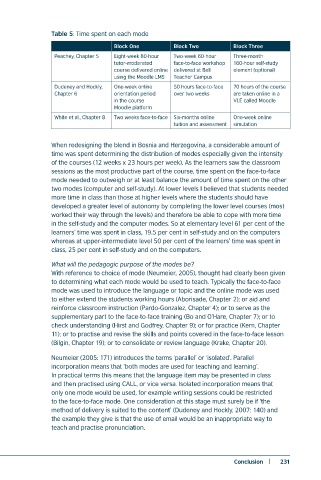
Table 5: Time spent on each mode
                                Block One        Block Two       Block Three
                Peachey, Chapter 5  Eight-week 80-hour   Two-week 60-hour   Three-month
                                tutor-moderated   face-to-face workshop   160-hour self-study
                                course delivered online  delivered at Bell   element (optional)
                                using the Moodle LMS   Teacher Campus
                Dudeney and Hockly,   One-week online   50 hours face-to-face   70 hours of the course
                Chapter 6       orientation period    over two weeks   are taken online in a
                                in the course                    VLE called Moodle
                                Moodle platform
                White et al., Chapter 8  Two weeks face-to-face  Six-months online   One-week online
                                                 tuition and assessment   simulation

               When redesigning the blend in Bosnia and Herzegovina, a considerable amount of
               time was spent determining the distribution of modes especially given the intensity
               of the courses (12 weeks x 23 hours per week). As the learners saw the classroom
               sessions as the most productive part of the course, time spent on the face-to-face
               mode needed to outweigh or at least balance the amount of time spent on the other
               two modes (computer and self-study). At lower levels I believed that students needed
               more time in class than those at higher levels where the students should have
               developed a greater level of autonomy by completing the lower level courses (most
               worked their way through the levels) and therefore be able to cope with more time
               in the self-study and the computer modes. So at elementary level 61 per cent of the
               learners’ time was spent in class, 19.5 per cent in self-study and on the computers
               whereas at upper-intermediate level 50 per cent of the learners’ time was spent in
               class, 25 per cent in self-study and on the computers.

               What will the pedagogic purpose of the modes be?
               With reference to choice of mode (Neumeier, 2005), thought had clearly been given
               to determining what each mode would be used to teach. Typically the face-to-face
               mode was used to introduce the language or topic and the online mode was used
               to either extend the students working hours (Aborisade, Chapter 2); or aid and
               reinforce classroom instruction (Pardo-Gonzalez, Chapter 4); or to serve as the
               supplementary part to the face-to-face training (Bo and O’Hare, Chapter 7); or to
               check understanding (Hirst and Godfrey, Chapter 9); or for practice (Kern, Chapter
               11); or to practise and revise the skills and points covered in the face-to-face lesson
               (Bilgin, Chapter 19); or to consolidate or review language (Krake, Chapter 20).

               Neumeier (2005: 171) introduces the terms ‘parallel’ or ‘isolated’. Parallel
               incorporation means that ‘both modes are used for teaching and learning’.
               In practical terms this means that the language item may be presented in class
               and then practised using CALL, or vice versa. Isolated incorporation means that
               only one mode would be used, for example writing sessions could be restricted
               to the face-to-face mode. One consideration at this stage must surely be if ‘the
               method of delivery is suited to the content’ (Dudeney and Hockly, 2007: 140) and
               the example they give is that the use of email would be an inappropriate way to
               teach and practise pronunciation.


 230   |  Conclusion                                              Conclusion  |   231

