


Page 165 - phytochemistry I - PharmD Clinical
P. 165
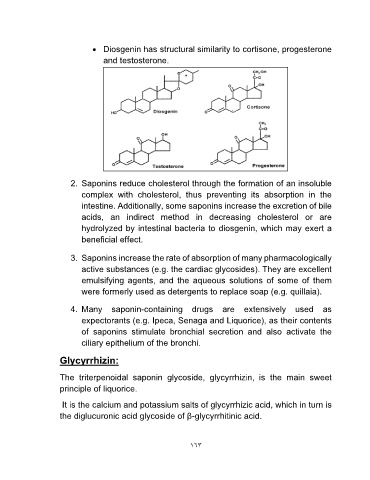
• Diosgenin has structural similarity to cortisone, progesterone
               and testosterone.

   2. Saponins reduce cholesterol through the formation of an insoluble
       complex with cholesterol, thus preventing its absorption in the
       intestine. Additionally, some saponins increase the excretion of bile
       acids, an indirect method in decreasing cholesterol or are
       hydrolyzed by intestinal bacteria to diosgenin, which may exert a
       beneficial effect.

   3. Saponins increase the rate of absorption of many pharmacologically
       active substances (e.g. the cardiac glycosides). They are excellent
       emulsifying agents, and the aqueous solutions of some of them
       were formerly used as detergents to replace soap (e.g. quillaia).

   4. Many saponin-containing drugs are extensively used as
       expectorants (e.g. Ipeca, Senaga and Liquorice), as their contents
       of saponins stimulate bronchial secretion and also activate the
       ciliary epithelium of the bronchi.

Glycyrrhizin:

The triterpenoidal saponin glycoside, glycyrrhizin, is the main sweet
principle of liquorice.
It is the calcium and potassium salts of glycyrrhizic acid, which in turn is
the diglucuronic acid glycoside of β-glycyrrhitinic acid.

                                                      ۱٦۳

