


Page 197 - Demo
P. 197
JOHN
various festivals and met serious opposition long before his death (Jn 2:14–25; 5; 7–8); and that he was put to death on the day before Passover (Jn 18:28). These events are not always in chronological order because of the development and editing that took place. However, the accuracy of much of the detail of the fourth gospel constitutes a strong argument that the Johannine tradition rests upon the testimony of an eyewitness. Although tradition identified this person as John, the son of Zebedee, most modern scholars find that the evidence does not support this.
The fourth gospel is not simply history; the narrative has been organized and adapted to serve the evangelist’s theological purposes as well. Among them are the opposition to the synagogue of the day and to John the Baptist’s followers, who tried to exalt their master at Jesus’ expense, the desire to show that Jesus was the Messiah, and the desire to convince Christians that their religious belief and practice must be rooted in Jesus. Such theological purposes have impelled the evangelist to emphasize motifs that were not so clear in the synoptic account of Jesus’ ministry, e.g., the explicit emphasis on his divinity.
The polemic between synagogue and church produced bitter and harsh invective, especially regarding the hostility toward Jesus of the authorities—Pharisees and Sadducees—who are combined and referred to frequently as “the Jews” (see note on Jn 1:19). These opponents are even described in Jn 8:44 as springing from their father the devil, whose conduct they imitate in opposing God by rejecting Jesus, whom God has sent. On the other hand, the author of this gospel
seems to take pains to show that women are not inferior to men in the Christian community: the woman at the well in Samaria (Jn 4) is presented as a prototype of a missionary (Jn 4:4–42), and the first witness of the resurrection is a woman (Jn 20:11–18).
The final editing of the gospel and arrange- ment in its present form probably dates from between A.D. 90 and 100. Traditionally, Ephesus has been favored as the place of composition, though many support a location in Syria, perhaps the city of Antioch, while some have suggested other places, including Alexandria.
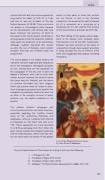
Icon of the Wedding Feast at Cana by Joan Brand-Landkamer
185
The principal divisions of the Gospel according to John are the following:
I. II. III. IV.
I. Prologue (1:1–18)
The Book of Signs (1:19–12:50)
The Book of Glory (13:1–20:31)
Epilogue: The Resurrection Appearance in Galilee (21:1–25)


