


Page 202 - Demo
P. 202
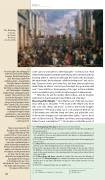
The Wedding at Cana, by Paolo Veronese (1528-1588)
2:1 Jesus’ rst sign is the changing of water into wine at the wedding banquet. On the literal level, he saves the young couple from embarrassment—it would have brought shame to them and their families to run out of wine. But there is a deeper meaning as well. The banquet is a familiar image of God’s coming among his people: “The Lord of hosts / will provide for all peoples / A feast of rich food and choice wines, / juicy, rich food and pure, choice wine” (Isaiah 25:6). Jesus comes, transforming the ordinary— stale water kept not for use in cooking but simply for ritual puri cations—into something extraordinary, “good wine” that no one has tasted until now (2:10).
2:4 Mary is never named in the Gospel of John—instead, she is always referred to as “the mother of Jesus.” Jesus’ words to his mother sound harsh: he calls her “woman,” which would not have been considered rude or harsh, but would certainly have been an unusually formal way to address one’s mother. He resists her request, on the grounds that his “hour” has not yet come. Mary does not argue with him, but simply tells the servants to do whatever he says. Jesus anticipates his “hour”—his saving life, death, and resurrection—at the request of his mother.
190
JOHN
some out now and take it to the headwaiter.”* So they took it. 9And when the headwaiter tasted the water that had become wine, without knowing where it came from (although the servers who had drawn the water knew), the headwaiter called the bridegroom 10and said to him, “Everyone serves good wine rst, and then when people have drunk freely, an inferior one; but you have kept the good wine until now.” 11Jesus did this as the beginning of his signs* in Cana in Galilee and so revealed his glory, and his disciples began to believe in him.e
12* After this, he and his mother, [his] brothers, and his disciples went down to Capernaum and stayed there only a few days.* Cleansing of the Temple. 13* Since the Passover* of the Jews was near,f Jesus went up to Jerusalem. 14* He found in the temple area those who sold oxen, sheep, and doves,* as well as the money-changers seated there.g 15He made a whip out of cords and drove them all out of the temple area, with the sheep and oxen, and spilled the coins of the money-changers and overturned their tables, 16and to those who sold doves he said, “Take these out of here, and stop making my Father’s house a marketplace.”h 17* His disciples recalled the words of
* [2:11] The beginning of his signs: the rst of seven (see Introduction).
* [2:12–3:21] The next three episodes take place in Jerusalem. Only the rst is paralleled in
the synoptic gospels.
* [2:12] This transitional verse may be a harmonization with the synoptic tradition in Lk
4:31 and Mt 4:13. There are many textual variants. John depicts no extended ministry in
Capernaum as do the synoptics.
* [2:13–22] This episode indicates the post-resurrectional replacement of the temple by the
person of Jesus.
* [2:13] Passover: this is the rst Passover mentioned in John; a second is mentioned in Jn 6:4;
a third in Jn 13:1. Taken literally, they point to a ministry of at least two years.
* [2:14–22] The other gospels place the cleansing of the temple in the last days of Jesus’ life (Matthew, on the day Jesus entered Jerusalem; Mark, on the next day). The order of events in the gospel narratives is often determined by theological motives rather than by
chronological data.
* [2:14] Oxen, sheep, and doves: intended for sacri ce. The doves were the o erings of
the poor (Lv 5:7). Money-changers: for a temple tax paid by every male Jew more than nineteen years of age, with a half-shekel coin (Ex 30:11–16), in Syrian currency. See note on Mt 17:24.
* [2:17] Ps 69:10, changed to future tense to apply to Jesus.
e. [2:11] 4:54. g. [2:14] Ex 30:11–16; Lv 5:7. f. [2:13–22] Mt 21:12–13; Mk 11:15–17; Lk 19:45–46. h. [2:16] Zec 14:21.


