


Page 21 - Demo
P. 21
MATTHEW
The Birth of Jesus.* 18Now this is how the birth of Jesus Christ came about. When his mother Mary was betrothed to Joseph,* but before they lived together, she was found with child through the holy Spirit. 19Joseph her husband, since he was a righteous man,* yet unwilling to expose her to
shame, decided to divorce her quietly. 20j Such was his intention when, behold, the angel of the Lord* appeared to him in a dream and said, “Joseph, son of David, do not be afraid to take Mary your wife into your home. For it is through the holy Spirit that this child has been conceived in her. 21She will bear a son and you are to name him Jesus,* because he will save his people from their sins.” 22All this took place to fulfill what the Lord had said through the prophet:
23* k “Behold, the virgin shall be with child and bear a son, and they shall name him Emmanuel,”
which means “God is with us.” 24When Joseph awoke, he did as the angel of the Lord had commanded him and took his wife into his home. 25He had no relations with her until she bore a son,* and he named him Jesus.l
1:18
In the Jewish custom of the time, a couple would be betrothed, sometimes for
several months, before living together as a married couple. If they were unfaithful to each other during this time of betrothal, it was considered adultery, and for women, adultery could be a capital o ense, punished by stoning.
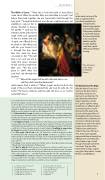
The Adoration of the Magi by Mathias Stomer
The Adoration of the Magi:
After the birth of Jesus, wise men from the East come to Jerusalem, not just to see him, but to worship him. The gifts they bring reveal their deeper awareness of who
he is: gold is a gift for a king; frankincense is o ered to God in worship; myrrh is used in
the burial of the dead. In the Church, the liturgical feast of the Epiphany (the word means “manifestation”) celebrates this moment, in which God reveals salvation not only to the Jewish people, but to all the nations. Tradition has added much detail to the story of the wise men. Artists have typically represented them as being from di erent races and ethnicities, and of various ages as well. Though the Gospel calls them “wise men,” they are often represented as kings. Legend even gives them names: Caspar, Melchior, and Balthasar.
9
* [1:18–25] This rst story of the infancy narrative spells out what is summarily indicated in Mt 1:16. The virginal conception of Jesus is the work of the Spirit of God. Joseph’s decision to divorce Mary is overcome by the heavenly command that he take her into his home and accept the child as his own. The natural genealogical line is broken but the promises to David are ful lled; through Joseph’s adoption the child belongs to the family of David. Matthew sees the virginal conception as the ful llment of Is 7:14.
* [1:18] Betrothed to Joseph: betrothal was the rst part of the marriage, constituting a man and woman as husband and wife. Subsequent in delity was considered adultery. The betrothal was followed some months later by the husband’s taking his wife into his home, at which time normal married life began.
* [1:19] A righteous man: as a devout observer of the Mosaic law, Joseph wished to break his union with someone whom he suspected of gross violation of the law. It is commonly said that the law required him to do so, but the texts usually given in support of that view, e.g., Dt 22:20–21 do not clearly pertain to Joseph’s situation. Unwilling to expose her to shame: the penalty for proved adultery was death by stoning; cf. Dt 22:21–23.
* [1:20] The angel of the Lord: in the Old Testament a common designation of God in communication with a human being. In a dream: see Mt 2:13, 19, 22. These dreams may be meant to recall the dreams of Joseph, son of Jacob the patriarch (Gn 37:5–11, 19). A closer parallel is the dream of Amram, father of Moses, related by Josephus (Antiquities 2:212, 215–16).
* [1:21] Jesus: in rst-century Judaism the Hebrew name Joshua (Greek Iēsous) meaning “Yahweh helps” was interpreted as “Yahweh saves.”
* [1:23] God is with us: God’s promise of deliverance to Judah in Isaiah’s time is seen by Matthew as ful lled in the birth of Jesus, in whom God is with his people. The name Emmanuel is alluded to at the end of the gospel where the risen Jesus assures his disciples of his continued presence, “. . . I am with you always, until the end of the age” (Mt 28:20).
* [1:25] Until she bore a son: the evangelist is concerned to emphasize that Joseph was not responsible for the conception of Jesus. The Greek word translated “until” does not imply normal marital conduct after Jesus’ birth, nor does it exclude it.
a. [1:1] Gn 5:1; 1 Chr 17:11; Gn 22:18. b.[1:2–17] Lk 3:23–38.
c. [1:2] Gn 21:3; 25:26; 29:35; 1 Chr 2:1. d.[1:3] Gn 38:29–30; Ru 4:18; 1 Chr 2:4–9. e. [1:4] Ru 4:19–20; 1 Chr 2:10–11.
f. [1:5] Ru 4:21–22; 1 Chr 2:11–12.
g.[1:6] 2 Sm 12:24; 1 Chr 2:15; 3:5. h.[1:7–11] 2 Kgs 25:1–21; 1 Chr 3:10–15. i. [1:12–16] 1 Chr 3:16–19.
j. [1:20] 2:13, 19; Lk 1:35.
k. [1:23] Is 7:14 LXX.
l. [1:25] Lk 2:7.


