


Page 22 - Demo
P. 22
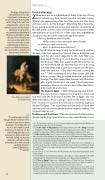
The reign of King Herod extended from 37 to 4 BC. Herod reacts to the news of Jesus’ birth with fear, thinking of this “king of the Jews” as a military leader, come to take away his power and his throne. Herod tries to destroy this perceived threat by killing all the boys in Bethlehem under the age of two. What Herod does not understand is that Jesus does not come to take something away from us, to control us or limit our freedom. He comes to ll us with life and lead us into true freedom.
The ight into Egypt, by Rembrandt
2:16 “The children die for Christ, though they do not know it. The parents mourn for the death of martyrs. The child makes of those as yet unable to speak t witnesses to himself. See the kind of kingdom that is his, coming as he did in order to be this kind of king. See how the deliverer is already working deliverance, the savior already working salvation” (Saint Quodvultdeus, 5th century).
10
MATTHEW
2The Visit of the Magi.*
1When Jesus was born in Bethlehem of Judea, in the days of King
*2 Herod, behold, magi from the east arrived in Jerusalem, saying,
“Where is the newborn king of the Jews? We saw his star* at its rising and have come to do him homage.”a 3When King Herod heard this, he was greatly troubled, and all Jerusalem with him. 4Assembling all the chief priests and the scribes of the people, he inquired of them where the Messiah was to be born.* 5b They said to him, “In Bethlehem of Judea, for thus it has been written through the prophet:
6‘And you, Bethlehem, land of Judah,
are by no means least among the rulers of Judah;
since from you shall come a ruler,
who is to shepherd my people Israel.’”
7Then Herod called the magi secretly and ascertained from them the time of the star’s appearance. 8He sent them to Bethlehem and said, “Go and search diligently for the child. When you have found him, bring me word, that I too may go and do him homage.” 9After their audience with the king they set out. And behold, the star that they had seen at its rising preceded them, until it came and stopped over the place where the child was. 10They were overjoyed at seeing the star, 11* c and on entering the house they saw the child with Mary his mother. They prostrated themselves and did him homage. Then they opened their treasures and offered him gifts of gold, frankincense, and myrrh. 12And having been warned in a dream not to return to Herod, they departed for
their country by another way.
The Flight to Egypt. 13* When they had departed, behold, the angel of the Lord appeared to Joseph in a dream and
said, “Rise, take the child and his mother, flee to Egypt,* and stay there until I tell you. Herod is going to search for the child to destroy him.” 14Joseph rose and took the child and his mother by night and departed for Egypt. 15* He stayed there until the death of Herod, that what the Lord had said through the prophetd might be fulfilled, “Out of Egypt I called my son.”
The Massacre of the Infants. 16When Herod realized that he had been deceived by the magi, he became furious. He ordered the massacre of
* [2:1–12] The future rejection of Jesus by Israel and his acceptance by the Gentiles are retrojected into this scene of the narrative.
* [2:1] In the days of King Herod: Herod reigned from 37 to 4 B.C. Magi: originally a designation of the Persian priestly caste, the word became used of those who were regarded as having more than human knowledge. Matthew’s magi are astrologers.
* [2:2] We saw his star: it was a common ancient belief that a new star appeared at the time of a ruler’s birth. Matthew also draws upon the Old Testament story of Balaam, who had prophesied that “A star shall advance from Jacob” (Nm 24:17), though there the star means not an astral phenomenon but the king himself.
* [2:4] Herod’s consultation with the chief priests and scribes has some similarity to a Jewish legend about the child Moses in which the “sacred scribes” warn Pharaoh about the imminent birth of one who will deliver Israel from Egypt and the king makes plans to destroy him.
* [2:11] Cf. Ps 72:10, 15; Is 60:6. These Old Testament texts led to the interpretation of the magi as kings.
* [2:13–23] Biblical and nonbiblical traditions about Moses are here applied to the child Jesus, though the dominant Old Testament type is not Moses but Israel (Mt 2:15).
* [2:13] Flee to Egypt: Egypt was a traditional place of refuge for those eeing from danger in Palestine (see 1 Kgs 11:40; Jer 26:21), but the main reason why the child is to be taken to Egypt is that he may relive the Exodus experience of Israel.
* [2:15] The ful llment citation is taken from Hos 11:1. Israel, God’s son, was called out of Egypt at the time of the Exodus; Jesus, the Son of God, will similarly be called out of that land in a new exodus. The father-son relationship between God and the nation is set in a higher key. Here the son is not a group adopted as “son of God,” but the child who, as


