


Page 24 - Demo
P. 24
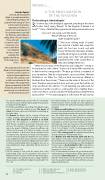
John the Baptist:
Dressed, like the prophet Elijah, in a rough animal skin, John the Baptist prepares the people for the coming of Christ in their midst. He preaches repentance. He minces no words in his condemnation of his contemporaries, especially the Pharisees and Sadducees, calling them a “brood of vipers.”
Those who take to heart his call to conversion come to the Jordan River to be baptized by John, a ritual washing that signi es their desire for the forgiveness of sins.
The Jordan River ows into the Dead Sea. Stretching more than 150 miles north to south, it is a place of great signi cance of Israel, and continues to be a vital source of water for the entire region. The Jordan River gures prominently in the Old Testament, where the Israelites miraculously cross the river into the land of God’s promise.
MATTHEW
II. THE PROCLAMATION OF THE KINGDOM
3The Preaching of John the Baptist.*
a 1In those days John the Baptist appeared, preaching in the desert
*2*
of Judea [and] saying, “Repent, for the kingdom of heaven is at
hand!”b 3* It was of him that the prophet Isaiahc had spoken when he said:
“A voice of one crying out in the desert, ‘Prepare the way of the Lord,
make straight his paths.’”
4* d John wore clothing made of camel’s hair and had a leather belt around his waist. His food was locusts and wild honey. 5At that time Jerusalem, all Judea, and the whole region around the Jordan were going out to him 6and were being baptized by him in the Jordan River as they acknowledged their sins.*
7 When he saw many of the Pharisees and Sadducees* coming to his baptism, he said to them, “You brood of vipers! Who warned you to flee from the coming wrath?e 8Produce good fruit as evidence of your repentance. 9And do not presume to say to yourselves, ‘We have Abraham as our father.’ For I tell you, God can raise up children to Abraham from these stones.f 10Even now the ax lies at the root of the trees. Therefore every tree that does not bear good fruit will be cut down and thrown into the fire. 11g I am baptizing you with water, for repentance, but the one who is coming after me is mightier than I. I am not worthy to carry his sandals. He will baptize you with the holy Spirit and fire.* 12* h His winnowing fan is in his hand. He will clear his
* [3:1–12] Here Matthew takes up the order of Jesus’ ministry found in the gospel of Mark, beginning with the preparatory preaching of John the Baptist.
* [3:1] Unlike Luke, Matthew says nothing of the Baptist’s origins and does not make him a relative of Jesus. The desert of Judea: the barren region west of the Dead Sea extending up the Jordan valley.
* [3:2] Repent: the Baptist calls for a change of heart and conduct, a turning of one’s life from rebellion to obedience towards God. The kingdom of heaven is at hand: “heaven” (lit., “the heavens”) is a substitute for the name “God” that was avoided by devout Jews of the time out of reverence. The expression “the kingdom of heaven” occurs only in the gospel of Matthew. It means the e ective rule of God over his people. In its fullness it includes not only human obedience to God’s word, but the triumph of God over physical evils, supremely over death. In the expectation found in Jewish apocalyptic, the kingdom was to be ushered in by a judgment in which sinners would be condemned and perish, an expectation shared by the Baptist. This was modi ed in Christian understanding where the kingdom was seen as being established in stages, culminating with the parousia of Jesus.
* [3:3] See note on Jn 1:23.
* [3:4] The clothing of John recalls the austere dress of the
prophet Elijah (2 Kgs 1:8). The expectation of the return of Elijah from heaven to prepare Israel for the nal manifestation of God’s kingdom was widespread, and according to Matthew this expectation was ful lled in the Baptist’s ministry (Mt 11:14; 17:11–13).
*[3:6] Ritual washing was practiced by various groups in Palestine between 150 B.C. and A.D. 250. John’s baptism may have been related to the puri catory washings of the Essenes at Qumran.
* [3:7] Pharisees and Sadducees: the former were marked by devotion to the law, written and oral, and the scribes, experts in the law, belonged predominantly to this group. The Sadducees were the priestly aristocratic party, centered in Jerusalem. They accepted as scripture only the rst ve books of the Old Testament, followed only the letter of the law, rejected the oral legal traditions, and were opposed to teachings not found in the Pentateuch, such as the resurrection of the dead. Matthew links both of these groups together as enemies of Jesus (Mt 16:1, 6, 11, 12; cf. Mk 8:11–13, 15). The threatening words that follow are addressed to them rather than to “the crowds” as in Lk 3:7. The coming wrath: the judgment that will bring about the destruction of unrepentant sinners.
* [3:11] Baptize you with the holy Spirit and re: the water baptism of John will be followed by an “immersion” of the repentant in the cleansing power of the Spirit of God, and of the unrepentant in the destroying power of God’s judgment. However, some see the holy Spirit and re as synonymous, and the e ect of this “baptism” as either puri cation or destruction. See note on Lk 3:16.
* [3:12] The discrimination between the good and the bad is compared to the procedure by which a farmer separates wheat and cha . The winnowing fan was a forklike shovel with which the threshed wheat was thrown into the air. The kernels fell to the ground; the light cha , blown o by the wind, was gathered and burned up.
a. [3:1–12] Mk 1:2–8; Lk 3:2–17.
b. [3:2] 4:17; 10:7.
c. [3:3] Is 40:3.
d. [3:4] 11:7–8; 2 Kgs 1:8; Zec 13:4.
e. [3:7] 12:34; 23:33; Is 59:5.
f. [3:9] Jn 8:33, 39; Rom 9:7–8; Gal 4:21–31.
g. [3:11] Jn 1:26–27, 33; Acts 1:5.
h. [3:12] 13:30; Is 41:16; Jer 15:7.
12


