


Page 64 - Demo
P. 64
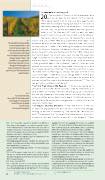
20:1 The parable of the workers in the vineyard ies in the face of human logic. Yes, all are paid what they were promised, but still, those who worked and waited the longest expect more. The parable is not a guide for running a business: it is an image of the kingdom of God, in which the love and generosity of God exceeds all expectations.
20:17 For the third time, Jesus tells his disciples what will happen in Jerusalem: he will be put to death on the cross, but he will rise again.
* [20:1–16] This parable is peculiar to Matthew. It is di cult to know whether the evangelist composed it or received it as part of his traditional material and, if the latter is the case, what its original reference was. In its present context its close association with Mt 19:30 suggests that its teaching is the equality of all the disciples in the reward of inheriting eternal life.
* [20:4] What is just: although the wage is not stipulated as in the case of those rst hired, it will be fair.
* [20:8] Beginning with the last... the rst: this element of the parable has no other purpose than to show how the rst knew what the last were given (Mt 20:12).
* [20:13] I am not cheating you: literally, “I am not treating you unjustly.”
* [20:14–15] The owner’s conduct involves no violation of justice (Mt 20:4, 13), and that all the workers receive the same wage is due only to his generosity to the latest arrivals; the resentment of the rst comes from envy.
* [20:16] See note on Mt 19:30.
* [20:17–19] Cf. Mk 10:32–34. This is the third and the most detailed
of the passion predictions (Mt 16:21–23; 17:22–23). It speaks of Jesus’ being handed over to the Gentiles (Mt 27:2), his being
mocked (Mt 27:27–30), scourged (Mt 27:26), and cruci ed (Mt 27:31, 35). In all but the last of these points Matthew agrees with his Marcan source, but whereas Mark speaks of Jesus’ being killed (Mk 10:34), Matthew has the speci c to be... cruci ed.
* [20:20–28] Cf. Mk 10:35–45. The request of the sons of Zebedee, made through their mother, for the highest places of honor in the kingdom, and the indignation of the other ten disciples at this request, show that neither the two brothers nor the others have understood that what makes for greatness in the kingdom is not lordly power but humble service. Jesus gives the example, and his ministry of service will reach its highest point when he gives his life for the deliverance of the human race from sin.
* [20:20–21] The reason for Matthew’s making the mother the petitioner (cf. Mk 10:35) is not clear. Possibly he intends an allusion to Bathsheba’s seeking the kingdom for Solomon; see 1 Kgs 1:11– 21. Your kingdom: see note on Mt 16:28.
* [20:22] You do not know what you are asking: the Greek verbs are plural and, with the rest of the verse, indicate that the answer is addressed not to the woman but to her sons. Drink the cup: see note on Mk 10:38–40. Matthew omits the Marcan “or be baptized with the baptism with which I am baptized” (Mk 10:38).
c. [20:20–28] Mk 10:35–45.
52
a. [20:8] Lv 19:13; Dt 24:15.
b. [20:17–19] 16:21; 17:22–23; Mk 10:32–34; Lk 18:31–33.
MATTHEW
The Workers in the Vineyard.*
201“The kingdom of heaven is like a landowner who
went out at dawn to hire laborers for his vineyard. 2After agreeing with them for the usual daily wage, he sent them into his vineyard. 3Going out about nine o’clock, he saw others standing idle in the marketplace, 4* and he said to them, ‘You too go into my vineyard, and I will give you what is just.’ 5So they went off. [And] he went out again around noon, and around three o’clock, and did likewise. 6Going out about five o’clock, he found others standing
around, and said to them, ‘Why do you stand here idle all day?’ 7They answered, ‘Because no one has hired us.’ He said to them, ‘You too go into my vineyard.’ 8* a When it was evening the owner of the vineyard said to his foreman, ‘Summon the laborers and give them their pay, beginning with the last and ending with the first.’ 9When those who had started about five o’clock came, each received the usual daily wage. 10So when the first came, they thought that they would receive more, but each of them also got the usual wage. 11And on receiving it they grumbled against the landowner, 12saying, ‘These last ones worked only one hour, and you have made them equal to us, who bore the day’s burden and the heat.’ 13He said to one of them in reply, ‘My friend, I am not cheating you.* Did you not agree with me for the usual daily wage? 14* Take what is yours and go. What if I wish to give this last one the same as you? 15[Or] am I not free to do as I wish with my own money? Are you envious because I am generous?’ 16* Thus, the last will be first, and the first will be last.”
The Third Prediction of the Passion.* 17b As Jesus was going up to Jerusalem, he took the twelve [disciples] aside by themselves, and said to them on the way, 18“Behold, we are going up to Jerusalem, and the Son of Man will be handed over to the chief priests and the scribes, and they will condemn him to death, 19and hand him over to the Gentiles to be mocked and scourged and crucified, and he will be raised on the third day.”
The Request of James and John.* 20c Then the mother* of the sons of Zebedee approached him with her sons and did him homage, wishing to ask him for something. 21He said to her, “What do you wish?” She answered him, “Command that these two sons of mine sit, one at your right and the other at your left, in your kingdom.” 22Jesus


