


Page 11 - Handout of Computer Architecture (1)..
P. 11
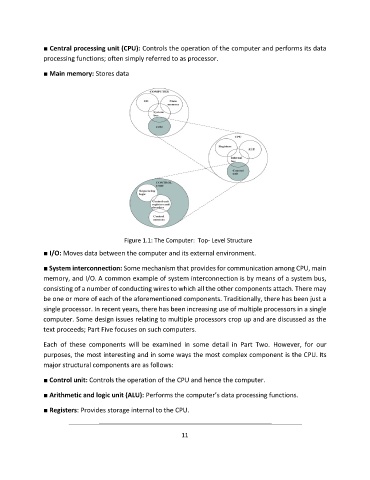
■ Central processing unit (CPU): Controls the operation of the computer and performs its data
               processing functions; often simply referred to as processor.

               ■ Main memory: Stores data


                                          Figure 1.1: The Computer:  Top- Level Structure

               ■ I/O: Moves data between the computer and its external environment.

               ■ System interconnection: Some mechanism that provides for communication among CPU, main
               memory, and I/O. A common example of system interconnection is by means of a system bus,
               consisting of a number of conducting wires to which all the other components attach. There may
               be one or more of each of the aforementioned components. Traditionally, there has been just a
               single processor. In recent years, there has been increasing use of multiple processors in a single
               computer. Some design issues relating to multiple processors crop up and are discussed as the
               text proceeds; Part Five focuses on such computers.

               Each  of  these  components  will  be  examined  in  some  detail  in  Part  Two.  However,  for  our
               purposes, the most interesting and in some ways the most complex component is the CPU. Its

               major structural components are as follows:

               ■ Control unit: Controls the operation of the CPU and hence the computer.

               ■ Arithmetic and logic unit (ALU): Performs the computer’s data processing functions.

               ■ Registers: Provides storage internal to the CPU.


                                                             11

