


Page 31 - Handout of Computer Architecture (1)..
P. 31
1.4 Later Generations

               Beyond  the  third  generation  there  is  less  general  agreement  on  defining  generations  of
               computers. Table 1.2 suggests that there have been a number of later generations, based on
               advances in integrated circuit technology. With the introduction of large- scale integration (LSI),
               more than 1,000 components can be placed on a single integrated circuit chip.

               Very-  large-  scale  integration  (VLSI)  achieved  more  than  10,000  components  per  chip,  while
               current ultra- large- scale integration (ULSI) chips can contain more than one billion components.
               With  the  rapid  pace  of  technology,  the  high  rate  of  introduction  of  new  products,  and  the
               importance of software and communications as well as hardware, the classification by generation
               becomes less clear and less meaningful.

               In this section, we mention two of the most important of developments in later generations.
               semiconductor memory the first application of integrated circuit technology to computers was

               the construction of the processor (the control unit and the arithmetic and logic unit) out of
               integrated  circuit  chips.  But  it  was  also  found  that  this  same  technology  could  be  used  to
               construct memories. In the 1950s and 1960s, most computer memory was constructed from tiny
               rings of ferromagnetic material, each about a sixteenth of an inch in diameter.

               These  rings  were  strung  up  on  grids  of  fine  wires  suspended  on  small  screens  inside  the
               computer. Magnetized one way, a ring (called a core) represented a one; magnetized the other
               way, it stood for a zero.

                Magnetic- core memory was rather fast; it took as little as a millionth of a second to read a bit

               stored in memory. But it was


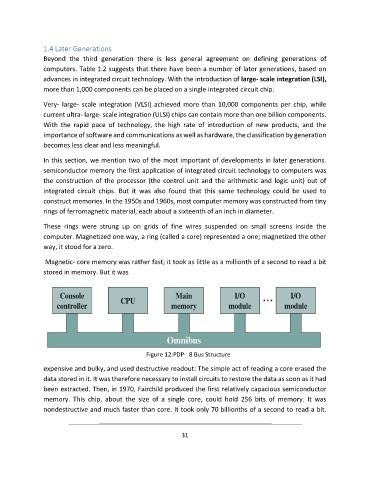
                                                 Figure 12:PDP-  8 Bus Structure

               expensive and bulky, and used destructive readout: The simple act of reading a core erased the

               data stored in it. It was therefore necessary to install circuits to restore the data as soon as it had
               been extracted. Then, in 1970, Fairchild produced the first relatively capacious semiconductor
               memory.  This  chip,  about  the  size  of  a  single  core,  could  hold  256  bits  of  memory.  It  was
               nondestructive and much faster than core. It took only 70 billionths of a second to read a bit.


                                                             31

