


Page 27 - Handout of Computer Architecture (1)..
P. 27
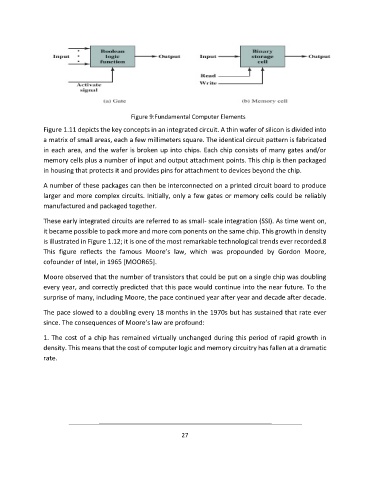
Figure 9:Fundamental Computer Elements
               Figure 1.11 depicts the key concepts in an integrated circuit. A thin wafer of silicon is divided into
               a matrix of small areas, each a few millimeters square. The identical circuit pattern is fabricated
               in each area, and the wafer is broken up into chips. Each chip consists of many gates and/or
               memory cells plus a number of input and output attachment points. This chip is then packaged
               in housing that protects it and provides pins for attachment to devices beyond the chip.


               A number of these packages can then be interconnected on a printed circuit board to produce
               larger and more complex circuits. Initially, only a few gates or memory cells could be reliably
               manufactured and packaged together.

               These early integrated circuits are referred to as small- scale integration (SSI). As time went on,
               it became possible to pack more and more com ponents on the same chip. This growth in density
               is illustrated in Figure 1.12; it is one of the most remarkable technological trends ever recorded.8
               This  figure  reflects  the  famous  Moore’s  law,  which  was  propounded  by  Gordon  Moore,
               cofounder of Intel, in 1965 [MOOR65].

               Moore observed that the number of transistors that could be put on a single chip was doubling
               every year, and correctly predicted that this pace would continue into the near future. To the

               surprise of many, including Moore, the pace continued year after year and decade after decade.

               The pace slowed to a doubling every 18 months in the 1970s but has sustained that rate ever
               since. The consequences of Moore’s law are profound:

               1. The cost of a chip has remained virtually unchanged during this period of rapid growth in
               density. This means that the cost of computer logic and memory circuitry has fallen at a dramatic
               rate.


                                                             27

