


Page 25 - Handout of Computer Architecture (1)..
P. 25
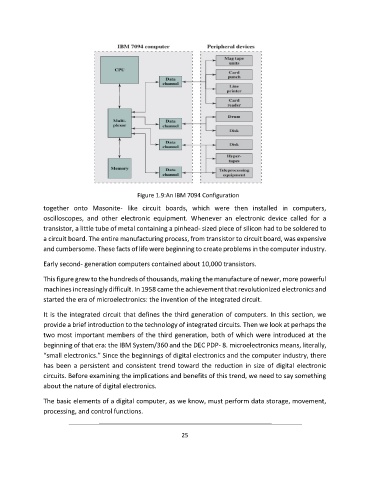
Figure 1.9:An IBM 7094 Configuration
               together  onto  Masonite-  like  circuit  boards,  which  were  then  installed  in  computers,
               oscilloscopes,  and  other  electronic  equipment.  Whenever  an  electronic  device  called  for  a
               transistor, a little tube of metal containing a pinhead- sized piece of silicon had to be soldered to

               a circuit board. The entire manufacturing process, from transistor to circuit board, was expensive
               and cumbersome. These facts of life were beginning to create problems in the computer industry.

               Early second- generation computers contained about 10,000 transistors.

               This figure grew to the hundreds of thousands, making the manufacture of newer, more powerful
               machines increasingly difficult. In 1958 came the achievement that revolutionized electronics and
               started the era of microelectronics: the invention of the integrated circuit.

               It is the integrated circuit that defines the third generation of computers. In this section, we
               provide a brief introduction to the technology of integrated circuits. Then we look at perhaps the
               two most important members of the third generation, both of which were introduced at the
               beginning of that era: the IBM System/360 and the DEC PDP- 8. microelectronics means, literally,

               “small electronics.” Since the beginnings of digital electronics and the computer industry, there
               has been  a persistent  and  consistent  trend toward  the  reduction  in  size  of  digital  electronic
               circuits. Before examining the implications and benefits of this trend, we need to say something
               about the nature of digital electronics.

               The basic elements of a digital computer, as we know, must perform data storage, movement,
               processing, and control functions.


                                                             25

