


Page 23 - Handout of Computer Architecture (1)..
P. 23
1.3.2 The Second Generation: Transistors
               The first major change in the electronic computer came with the replacement of the vacuum

               tube by the transistor. The transistor, which is smaller, cheaper, and generates less heat than a
               vacuum tube, can be used in the same way as a vacuum tube to construct computers. Unlike the
               vacuum tube, which requires wires, metal plates, a glass capsule, and a vacuum, the transistor is
               a solid- state device, made from silicon.

               The transistor was invented at Bell Labs in 1947 and by the 1950s had launched an electronic
               revolution. It was not until the late 1950s, however, that fully transistorized computers were
               commercially available. The use of the transistor defines the second generation of computers. It
               has become widely accepted to classify computers into generations based on the fundamental
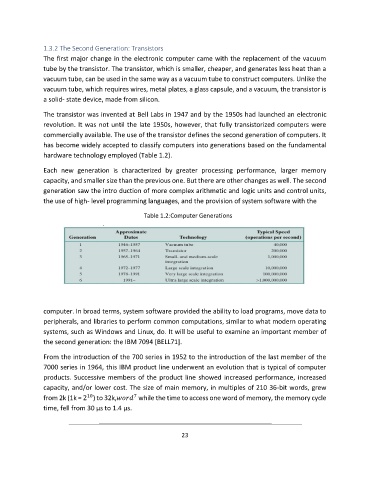
               hardware technology employed (Table 1.2).

               Each  new  generation  is  characterized  by  greater  processing  performance,  larger  memory

               capacity, and smaller size than the previous one. But there are other changes as well. The second
               generation saw the intro duction of more complex arithmetic and logic units and control units,
               the use of high- level programming languages, and the provision of system software with the

                                                 Table 1.2:Computer Generations


               computer. In broad terms, system software provided the ability to load programs, move data to
               peripherals, and libraries to perform common computations, similar to what modern operating
               systems, such as Windows and Linux, do. It will be useful to examine an important member of
               the second generation: the IBM 7094 [BELL71].

               From the introduction of the 700 series in 1952 to the introduction of the last member of the
               7000 series in 1964, this IBM product line underwent an evolution that is typical of computer
               products. Successive members of the product line showed increased performance, increased
               capacity, and/or lower cost. The size of main memory, in multiples of 210 36-bit words, grew
                                             7
                              10
               from 2k (1k = 2 ) to 32k,          while the time to access one word of memory, the memory cycle
               time, fell from 30 µs to 1.4 µs.


                                                             23

