


Page 18 - Handout of Computer Architecture (1)..
P. 18
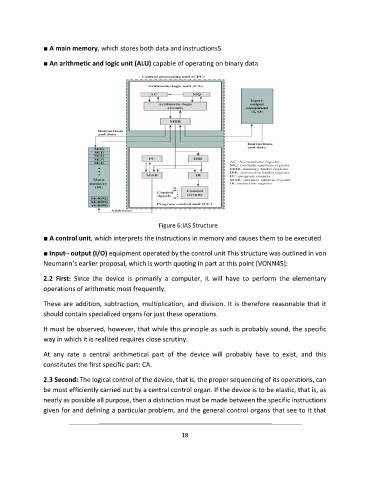
■ A main memory, which stores both data and instructions5

               ■ An arithmetic and logic unit (ALU) capable of operating on binary data


                                                      Figure 6:IAS Structure
               ■ A control unit, which interprets the instructions in memory and causes them to be executed


               ■ Input– output (I/O) equipment operated by the control unit This structure was outlined in von
               Neumann’s earlier proposal, which is worth quoting in part at this point [VONN45]:

               2.2  First:  Since  the  device  is  primarily  a  computer,  it  will  have  to  perform  the  elementary
               operations of arithmetic most frequently.

               These are addition, subtraction, multiplication, and division. It is therefore reasonable that it
               should contain specialized organs for just these operations.

               It must be observed, however, that while this principle as such is probably sound, the specific
               way in which it is realized requires close scrutiny.

               At  any  rate  a  central  arithmetical  part  of  the  device  will  probably  have  to  exist,  and  this
               constitutes the first specific part: CA.


               2.3 Second: The logical control of the device, that is, the proper sequencing of its operations, can
               be most efficiently carried out by a central control organ. If the device is to be elastic, that is, as
               nearly as possible all purpose, then a distinction must be made between the specific instructions
               given for and defining a particular problem, and the general control organs that see to it that


                                                             18

