


Page 46 - Handout of Computer Architecture (1)..
P. 46
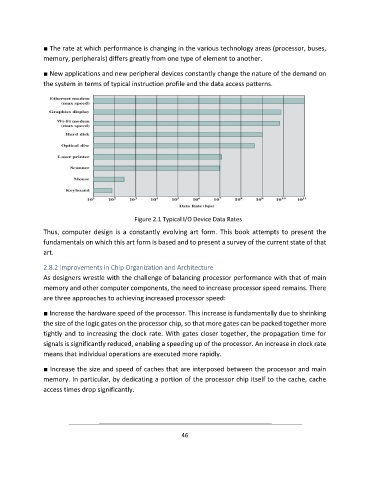
■ The rate at which performance is changing in the various technology areas (processor, buses,
               memory, peripherals) differs greatly from one type of element to another.

               ■ New applications and new peripheral devices constantly change the nature of the demand on

               the system in terms of typical instruction profile and the data access patterns.


                                              Figure 2.1 Typical I/O Device Data Rates
               Thus,  computer  design  is  a  constantly  evolving  art  form.  This  book  attempts  to  present  the
               fundamentals on which this art form is based and to present a survey of the current state of that
               art.

               2.8.2 Improvements in Chip Organization and Architecture

               As designers wrestle with the challenge of balancing processor performance with that of main
               memory and other computer components, the need to increase processor speed remains. There
               are three approaches to achieving increased processor speed:

               ■ Increase the hardware speed of the processor. This increase is fundamentally due to shrinking
               the size of the logic gates on the processor chip, so that more gates can be packed together more
               tightly and to increasing the clock rate. With gates closer together, the propagation time for
               signals is significantly reduced, enabling a speeding up of the processor. An increase in clock rate
               means that individual operations are executed more rapidly.


               ■ Increase the size and speed of caches that are interposed between the processor and main
               memory. In particular, by dedicating a portion of the processor chip itself to the cache, cache
               access times drop significantly.


                                                             46

