


Page 50 - Handout of Computer Architecture (1)..
P. 50
2.10 Two Laws That Provide insight: Amdahl’s Law and Little’s Law
               In this section, we look at two equations, called “laws.” The two laws are unrelated but both

               provide insight into the performance of parallel systems and multicore systems.

               Amdahl’s  Law  Computer  system designers  look for  ways  to improve  system  performance  by
               advances in technology or change in design. Examples include the use of parallel processors, the
               use of a memory cache hierarchy, and speedup in memory access time and I/O transfer rate due
               to technology improvements. In all of these cases, it is important to note that a speedup in one
               aspect  of  the  technology  or  design  does  not  result  in  a  corresponding  improvement  in
               performance. This limitation is succinctly expressed by Amdahl’s law.

               Amdahl’s law was first proposed by Gene Amdahl in 1967 ([AMDA67], [AMDA13]) and deals with
               the potential speedup of a program using multiple processors compared to a single processor.
               Consider a program running on a single processor such that a fraction (1- f) of the execution time

               involves code that is inherently sequential, and a fraction f that involves code that is infinitely
               parallelizable with no scheduling overhead. Let T be the total execution time of the program using
               a  single processor.  Then  the  speedup  using  a parallel  processor with  N  processors that  fully
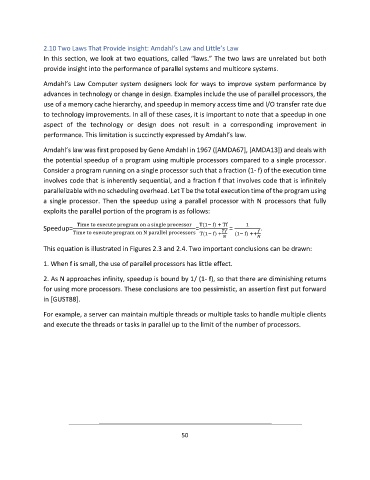
               exploits the parallel portion of the program is as follows:

                          Time to execute program on a single processor  T(1− f) + Tf  1
               Speedup=                                           =          =         .
                         Time to execute program on N parallel processors T(1− f) +       (1− f) ++

               This equation is illustrated in Figures 2.3 and 2.4. Two important conclusions can be drawn:

               1. When f is small, the use of parallel processors has little effect.

               2. As N approaches infinity, speedup is bound by 1/ (1- f), so that there are diminishing returns
               for using more processors. These conclusions are too pessimistic, an assertion first put forward
               in [GUST88].

               For example, a server can maintain multiple threads or multiple tasks to handle multiple clients
               and execute the threads or tasks in parallel up to the limit of the number of processors.


                                                             50

