


Page 53 - Handout of Computer Architecture (1)..
P. 53
When a signal is placed on a line inside the processor, it takes some finite amount of time for the
               voltage levels to settle down so that an accurate value (logical 1 or 0) is available.

               Furthermore,  depending  on  the  physical  layout  of  the  processor  circuits,  some  signals  may

               change more rapidly than others.

               Thus, operations must be synchronized and paced so that the proper electrical signal (voltage)
               values are available for each operation. quartz crystal analog to the execution of an instruction
               involves a number of discrete steps, such as fetching the instruction from memory, decoding the
               various  portions  of  the instruction,  loading  and  storing data,  and  performing  arithmetic  and
               logical operations.

               Thus, most instructions on most processors require multiple clock cycles to complete.

               Some instructions may take only a few cycles, while others require dozens. In addition, when
               pipelining  is  used,  multiple  instructions  are  being  executed  simultaneously.  Thus,  a  straight

               comparison  of  clock  speeds  on  different  processors  does  not  tell  the  whole  story  about
               performance.


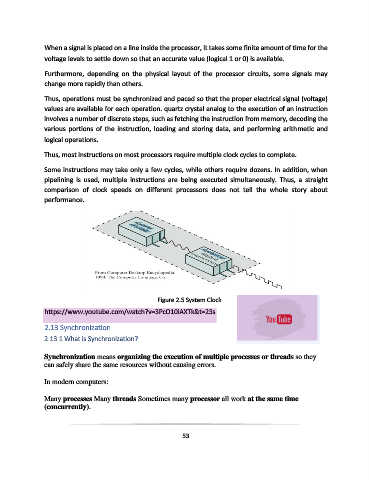
                                                     Figure 2.5 System Clock


               https://www.youtube.com/watch?v=3PcO10iAXTk&t=23s
               2.13 Synchronization
               2.13.1 What is Synchronization?


               Synchronization means organizing the execution of multiple processes or threads so they
               can safely share the same resources without causing errors.


               In modern computers:

               Many processes Many threads Sometimes many processor all work at the same time
               (concurrently).


                                                             53

