


Page 57 - Handout of Computer Architecture (1)..
P. 57
We can rewrite the preceding equation as T = Ic * [p + (m * k)] * t where p is the number of
               processor cycles needed to decode and execute the instruction, m is the number of memory

               references needed, and k is the ratio between memory cycle time and processor cycle time.

               The five performance factors in the preceding equation (Ic, p, m, k, t) are influenced by four
               system  attributes:  the  design  of  the  instruction  set  (known  as  instruction  set  architecture);
               compiler technology (how effective the compiler is in producing an efficient machine language
               program  from  a  high-level  language  program);  processor  implementation;  and  cache  and
               memory hierarchy.

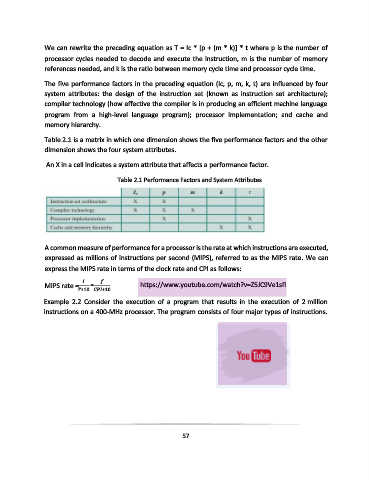
               Table 2.1 is a matrix in which one dimension shows the five performance factors and the other
               dimension shows the four system attributes.

                An X in a cell indicates a system attribute that affects a performance factor.

                                       Table 2.1 Performance Factors and System Attributes


               A common measure of performance for a processor is the rate at which instructions are executed,
               expressed as millions of instructions per second (MIPS), referred to as the MIPS rate. We can

               express the MIPS rate in terms of the clock rate and CPI as follows:


               MIPS rate =     =                       https://www.youtube.com/watch?v=Z5JC9Ve1sfI

                             ∗10       ∗10
               Example  2.2  Consider  the  execution  of  a  program  that  results  in  the  execution  of  2 million
               instructions on a 400-MHz processor. The program consists of four major types of instructions.


                                                             57

