


Page 62 - Handout of Computer Architecture (1)..
P. 62
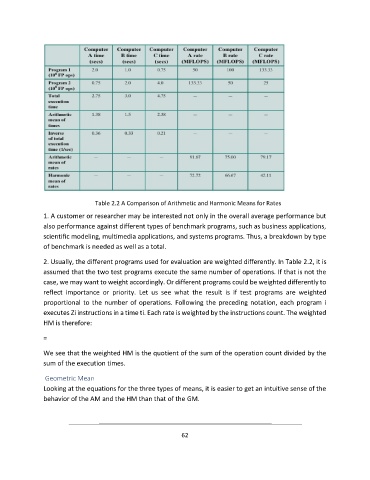
Table 2.2 A Comparison of Arithmetic and Harmonic Means for Rates

               1. A customer or researcher may be interested not only in the overall average performance but
               also performance against different types of benchmark programs, such as business applications,
               scientific modeling, multimedia applications, and systems programs. Thus, a breakdown by type
               of benchmark is needed as well as a total.

               2. Usually, the different programs used for evaluation are weighted differently. In Table 2.2, it is
               assumed that the two test programs execute the same number of operations. If that is not the

               case, we may want to weight accordingly. Or different programs could be weighted differently to
               reflect  importance  or  priority.  Let  us  see  what  the  result  is  if  test  programs  are  weighted
               proportional to the number of operations. Following the preceding notation, each program i
               executes Zi instructions in a time ti. Each rate is weighted by the instructions count. The weighted
               HM is therefore:

               =

               We see that the weighted HM is the quotient of the sum of the operation count divided by the
               sum of the execution times.

                Geometric Mean

               Looking at the equations for the three types of means, it is easier to get an intuitive sense of the
               behavior of the AM and the HM than that of the GM.


                                                             62

