


Page 58 - Handout of Computer Architecture (1)..
P. 58
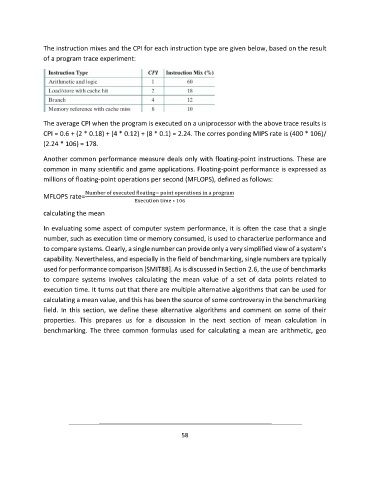
The instruction mixes and the CPI for each instruction type are given below, based on the result
               of a program trace experiment:


               The average CPI when the program is executed on a uniprocessor with the above trace results is
               CPI = 0.6 + (2 * 0.18) + (4 * 0.12) + (8 * 0.1) = 2.24. The corres ponding MIPS rate is (400 * 106)/
               (2.24 * 106) ≈ 178.

               Another common performance measure deals only with floating-point instructions. These are
               common in many scientific and game applications. Floating-point performance is expressed as
               millions of floating-point operations per second (MFLOPS), defined as follows:

                             Number of executed floating− point operations in a program
               MFLOPS rate=
                                             Execution time ∗ 106
               calculating the mean

               In evaluating some aspect of computer system performance, it is often the case that a single
               number, such as execution time or memory consumed, is used to characterize performance and

               to compare systems. Clearly, a single number can provide only a very simplified view of a system’s
               capability. Nevertheless, and especially in the field of benchmarking, single numbers are typically
               used for performance comparison [SMIT88]. As is discussed in Section 2.6, the use of benchmarks
               to  compare  systems  involves  calculating  the  mean  value  of  a  set  of  data  points  related  to
               execution time. It turns out that there are multiple alternative algorithms that can be used for
               calculating a mean value, and this has been the source of some controversy in the benchmarking
               field.  In  this  section,  we  define  these  alternative  algorithms and  comment  on  some of  their
               properties.  This  prepares  us  for  a  discussion  in  the  next  section  of  mean  calculation  in

               benchmarking.  The three  common formulas  used for  calculating  a  mean  are  arithmetic,  geo


                                                             58

